

The Eurovision Song Contest is heading towards its 70th edition, which will take place in Vienna (Austria) on May 12, 14, and 16 at the Wiener Stadthalle.
Little by little, the participating countries are immersed in preparations to shape the details of their entries with which they will compete to win the coveted glass microphone.
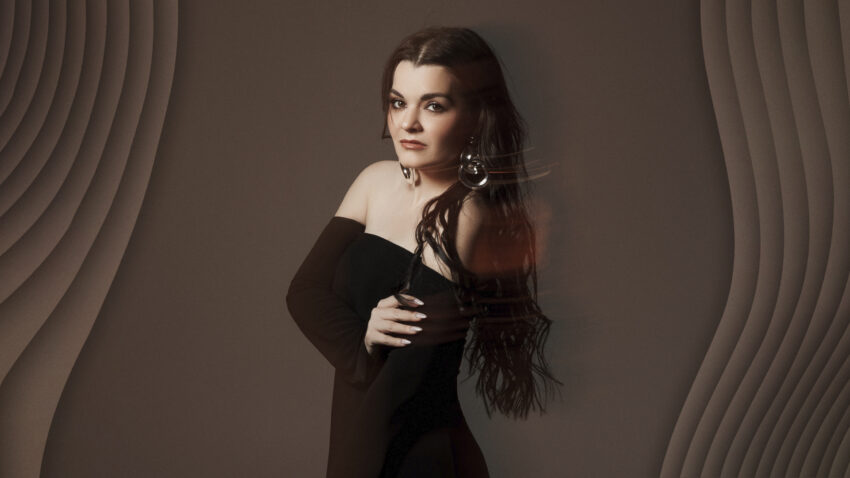
The Eurovision season has brought a wide variety of proposals, and among them stands out Latvia, which has opted for an entry with a strong distinct identity. The broadcaster LSM selected its representative through Supernova, where the singer Atvara managed to prevail with her entry “Ēnā”, securing her ticket to Vienna.
How has her journey to Eurovision been? What lies behind her musical proposal? How has she built a unique identity within the current music scene?
On this occasion, we review the musical career of Atvara, the context of her entry, and her song. The Latvian representative at the Eurovision Song Contest 2026 will attempt to take her country back to the Grand Final with “Ēnā”, a proposal that blends tradition and modernity on the European stage, in what will be Latvia’s 27th participation in the European contest.
This is Atvara, first contact with television and the stage
Liene Stūrmane, known professionally as Atvara, was born in 1993 in Liepāja, a Latvian city with a strong musical tradition. From an early age she grew up in an environment where music played a prominent role, which fostered the development of her artistic sensitivity and her interest in singing. She began her training in specialized centers in her hometown and later expanded it in Riga, where she specialized in modern singing with influences from jazz and pop, thus acquiring a versatile foundation that would define her style.
During her youth she began appearing on music television programs in Latvia, which allowed her to gain stage experience. In 2017 she participated in the Latvian version of The X Factor, taking on demanding repertoires that helped strengthen her technique and stage presence, despite not advancing in the competition.
Before establishing herself as an artist, she combined her musical vocation with other jobs. She worked as an English teacher and expanded her education in communication and marketing in Copenhagen. During this period she also collaborated with digital media and projects related to radio in Latvia, staying close to the cultural field.
Prior to her breakthrough as a performer, Atvara was already active as a songwriter, taking part in projects related to the Latvian Eurovision preselection, Supernova, and collaborating with other artists. The real boost to her career came in 2024, when she made her solo debut with “Pie manis tveries”. The song was very well received, reached the top 10 in Latvia and went viral on TikTok, as well as being part of the soundtrack of a television series.
In 2025 she continued to grow with new collaborations, including work alongside Intars Busulis, and made her debut as a presenter at the Gamma Awards. That same year she embarked on her first tour, with more than twenty concerts across the country. She also released “Dzīve mūs mētā”, included in her debut album, consolidating her position in the Latvian music scene.
This is “Ēnā”, the proposal by Atvara to represent Latvia at Eurovision 2026
Atvara represents Latvia at the Eurovision Song Contest 2026 with the song “Ēnā” (In the Shadow), composed by the artist herself in collaboration with Jānis Jačmenkins.
“Ēnā” conveys a feeling of emotional exhaustion and disconnection that happens little by little. The protagonist gives her best to others, even to those who are cold, but ends up feeling empty with those who truly matter to her. It is a song that reflects how someone can appear to be fine in front of the world, while inside they are slowly fading away. It is a gradual process of becoming “in the shadow.”
Lyrics
Latvian
Tik daudz silta
Aukstiem ļaudīm dots
Bet pie tuviem
Atnāc iztukšots
Citu acīm
Skaisti izgleznots
Bet viens piliens
Pārvērš tevi toņos melnbaltos
Un tā lēnām, lēnām
Kļūsti mēmāks
Lēni lēnām, lēnām
Paliec ēnā
Tu Domā “vēlāk, vēlāk, nedaudz vēlāk”
Un tā lēnām, lēnām
Paliec ēnā
Meitiņ klusē, veļu necilā
Šodien tētis mājās nepārnāks
Rīt ar smaidu glāzes skandinās
Slīksim kopā šaubu atvarā
Un tā lēnām, lēnām
Kļūsti mēmāks
Lēni lēnām, lēnām
Paliec ēnā
Tu Domā “vēlāk, vēlāk, nedaudz vēlāk”
Un tā lēnām, lēnām
Paliec ēnā
(Lēnām, lēnām)
(Lēnām, lēnām)
Lēnām, lēnām paliec ēnā
English
So much warmth is given for strangers in the cold
But you come home empty to the souls you hold
In other people’s eyes you’re painted bright
Yet one small drop turns you into black and white
Slowly, slowly you fade from the light
Slowly, slowly the dark feels right
You say “later… later… not today”
And slowly, slowly you drift away
Little girl, stay quiet, hold on tight
Your father won’t come home tonight
Tomorrow he’ll smile and raise his glass
While we drown in doubts that never pass
Latvia at Eurovision: A Quick History
Latvia debuted in Eurovision in 2000 with the group Brainstorm and has participated continuously since then, selecting its representatives through different national selections. Its early period included a 3rd place on its debut and a victory in 2002 with Marie N and «I Wanna».
After some good results, such as Aminata’s 6th place in 2015, the country went through difficult years without qualifying for the final. This streak lasted for several editions until 2024, when Dons and his intimate ballad “Hollow” achieved 16th place in the final. In 2025, the group Tautumeitas improved the Baltic country’s results with a 13th place, the best since 2015.