

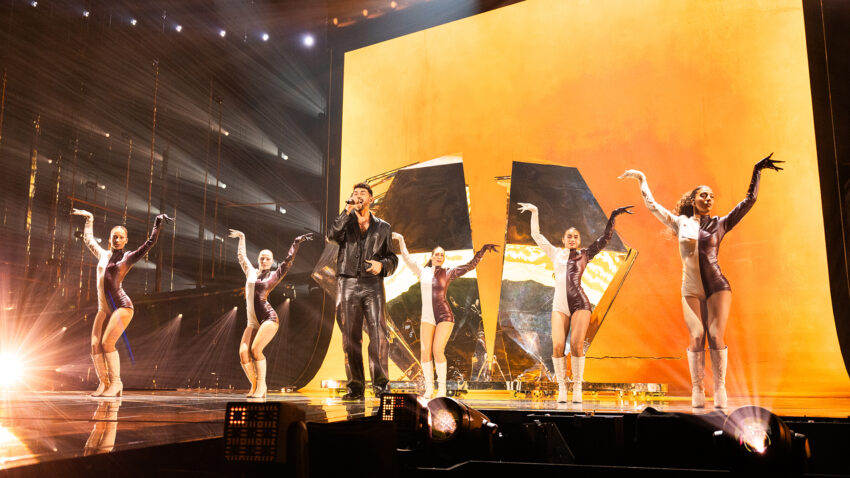
The first semifinal of the Eurovision Song Contest took place this Tuesday, May 12, at the Wiener Stadthalle in Vienna, surrounded by an unprecedented climate of tension due to the participation of Israel.
Its presence in the semifinal caused a live incident. At the moment when the Israeli performance was about to begin, an attendee could be heard in the official broadcast shouting “stop, stop, the genocide”. This incident led the European Broadcasting Union and the host broadcaster ORF to issue a brief statement explaining what happened.
The attendee, who was near a microphone, called for an end to the genocide in Gaza before Israel’s performance. This led the organizers to remove those voices from the YouTube broadcast. The EBU confirms that during the stage presentation at the beginning of the entries, commonly known as “stage ready”, and at the end of them, a clean feed of the audience sound is broadcast.
Si sente urlare “stop, stop the genocide” durante il brano di Israele all’Eurovision. pic.twitter.com/hTVh0YIDCU
— Trash Italiano (@trash_italiano) May 12, 2026
This allowed the attendee to be heard “expressing their discontent out loud.” The organizers state that during the performance the shouting continued as well. For this reason, the security of the Wiener Stadthalle had to intervene and expel the attendee along with three other people, in this case for “disruptive behavior” not specified by the organization.
“A crowd of 10,000 people at the Wiener Stadthalle, during the first semifinal of the 70th Eurovision Song Contest in Vienna, enthusiastically welcomed each artist tonight. As previously announced, ORF is broadcasting a clean audio feed from audience microphones before and during each performance.”
“A spectator, near a microphone, expressed their discontent out loud when the Israeli artist began their performance and during it, which was heard in the live broadcast. They were subsequently removed by security staff for continuing to disrupt the audience. Another three people were also removed from the venue by security staff for disruptive behavior.”
Joint statement of the European Broadcasting Union (EBU) and host broadcaster ORF
Demonstrations and protests in Vienna over Israel’s participation in Eurovision 2026
What is usually considered the best week of the year has this year been overshadowed by the Eurovision boycott, the absence of important countries, and an unprecedented climate of tension and discontent in the contest. This comes despite Vienna’s efforts to deliver a high-level opening event.
The Austrian capital aimed to vibrate to the rhythm of Eurovision music, but what is resonating across Europe are the voices and protests against Israel’s participation. In fact, in Vienna, major associations and groups have organized a series of meetings throughout the week to raise their voices against the genocide in Gaza and to criticize Israel’s presence in the contest, which they describe as an intolerable act of international “whitewashing.”
The reality is that protests against Israel’s participation have become a constant in recent editions of the Eurovision Song Contest, from the demonstrations outside the Malmö Arena in 2024, to the gatherings during the start of St. Jakobshalle in 2025, and even inside the venue during a dress rehearsal, which forced security teams to intervene.
According to Austrian law, protests must be registered at least 48 hours in advance. So far, no large-scale gatherings have taken place, but it is expected that during this Eurovision week there will be blockades, acts of vandalism, and spontaneous unauthorized protests.
To date, some demonstrations against Israel’s participation have been recorded, with an estimated attendance of up to 3,000 people.
“We expect that, indeed, there will be blockades and acts of vandalism, especially on the day of the grand final, whether through authorized or unauthorized gatherings”
Xenia Zauner, senior police official in Vienna
The local authorities estimate that the day of greatest tension will be Friday, May 15, on the occasion of the commemoration of Nakba Day, a date on which Palestinians remember the loss of their land after the 1948 war, following which the State of Israel was created.
Being a day with a “great emotional significance for the pro-Palestinian movement”, in the words of Xenia Zauner, the police are preparing to deal with a wide range of threats.
Among the measures imposed is the prohibition of drone use within a 1.5-kilometre radius of the key locations of the Eurovision Song Contest 2026 (Wiener Stadthalle, Eurovision Village, EuroCafe). In addition, there is cooperation with a task force at the United States Federal Bureau of Investigation (FBI), with which Austrian authorities will be able to maintain 24-hour contact to address cyber threats.
Currently, the terrorism alert level in Austria remains at the second highest level, as it has been for the past two years. Security forces emphasize that there is no specific threat against the Eurovision Song Contest, according to Dieter Csefan.
According to the police, those attending the event must expect airport-like security checks and will only be allowed to bring small, transparent bags inside the venue. These security measures will also be implemented in the live viewing area at Eurovision Village in front of Vienna City Hall.