

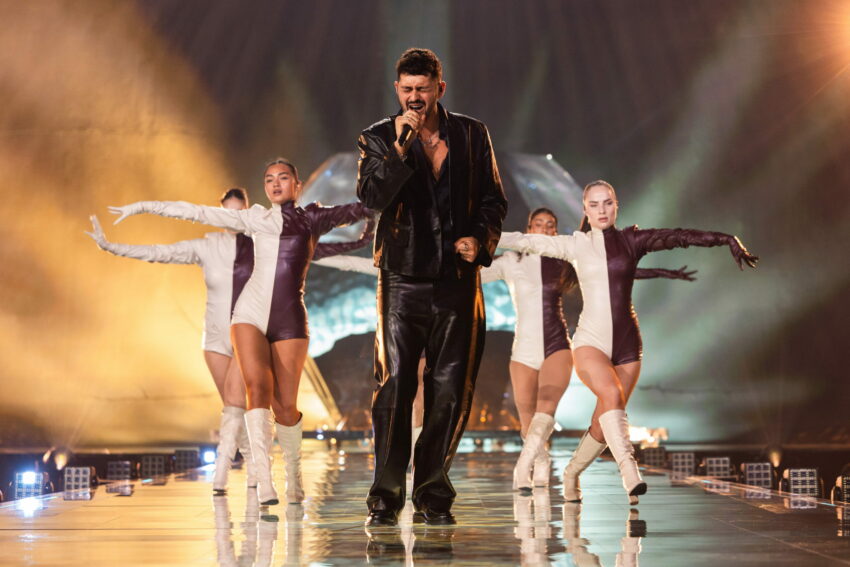
Despite the attempts by the European Broadcasting Union (EBU-UER) to control promotional campaigns carried out by participants in the Eurovision Song Contest, Israel once again enters the scene. Eurovision fans on social media have reported the beginning of the circulation of videos featuring Noam Bettan, the Israeli representative in Vienna 2026, asking viewers to vote for his entry.
The effort to attract viewer votes has begun just days before the first semifinal of the 70th edition of the European contest, in which Israel will compete for a place in the Grand Final.
The same format as in previous editions is being maintained, even with an identical staging in which the Israeli singer directly asks for votes for his song in different languages: Azerbaijani, Dutch, English, French, German, Greek, Italian, Maltese, Portuguese, Spanish, Swedish, and Ukrainian.
In addition, his voting number is displayed and special emphasis is placed on the fact that viewers can vote up to 10 times through the online platform, SMS, and telephone calls. The videos being circulated are focused on the first semifinal in which Israel is competing. All of them follow the same design and script, with the representative asking for votes alongside a short excerpt of his song.

It should be remembered that, in the last two editions, Israel carried out a massive video campaign orchestrated by the Israeli government communications agency (IGAA), which resulted in huge televote results that ended up disrupting the balance of the Eurovision voting system. On this occasion, for the moment, the scope of the videos that began circulating this Friday, May 8, through platforms such as YouTube and the social network X, remains unknown.
In contrast to the conciliatory words of Martin Green CBE, director of the Eurovision Song Contest, who on several occasions expressed his firm commitment to controlling these types of practices, the reality appears very different. Israel, acting as a free agent within the competition, continues with its strategy to mobilize the televote and disrupt the balance of the voting system. Despite the new regulations introduced in the contest, which specifically focused on controlling these types of campaigns, everything seems to remain the same and the EBU continues to show passivity toward these campaigns that violate the current Eurovision rules.
What do the Eurovision rules say about promotional campaigns?
The regulations seek to put an end to attempts by third parties to influence the voting. In other words, broadcasters may promote their candidates, but avoiding “disproportionate promotional campaigns (…) particularly when undertaken or supported by third parties, including governments or governmental bodies.” In this case, it is still too early to confirm that Israel’s dissemination strategy is financed by the country’s government. However, the format and aesthetics strongly suggest that this may be the case.
In these situations, the EBU should investigate these events, since the rules state that if “broadcasters and artists” participate “actively” in this type of third-party campaign, they may face “sanctions.”
“Participating broadcasters and artists are not permitted to actively participate in, facilitate, or contribute to third-party promotional campaigns that may influence the outcome of the voting and, as described in the updated Code of Conduct, any attempt to unduly influence the results will result in sanctions,” the Eurovision Song Contest regulations emphasize.
These new rules (limiting votes to 10 per payment method, the return of national juries to the semifinals, and controls on government campaigns) received broad support from EBU members during the 95th General Assembly in December 2025, which prevented a specific vote on Israel’s participation.
This situation led to the withdrawal of five countries (Slovenia, Spain, Ireland, Iceland, and the Netherlands) in protest against the presence of the Israeli broadcaster in the contest, resulting in an unprecedented boycott and a climate of tension never seen before.
For now, everything indicates that nothing has changed and that Israel still appears to enjoy impunity to continue maneuvering with the aim of gathering a massive televote capable of further unbalancing the voting format.
Despite the EBU’s expressed “concern” about political and third-party interference, for the moment it has remained silent regarding these first signs that Israel is attempting it once again. Martin Green CBE himself opened the door to self-criticism in an interview with the Dutch broadcaster NPO 2, where he stated that they had not been “strict enough” in recent editions. In this regard, he emphasized that the presence of national juries “balances the voting.” However, he was firm in stating that they will not tolerate any fraudulent activity or disproportionate voting. It remains to be seen whether the EBU will launch any kind of investigation into this Israeli campaign.