

The Eurovision Song Contest is heading towards its 70th edition, which will take place in Vienna (Austria) on May 12, 14, and 16 at the Wiener Stadthalle.
Little by little, the participating countries are immersed in preparations to refine the details of their entries with which they will compete to win the coveted glass microphone.
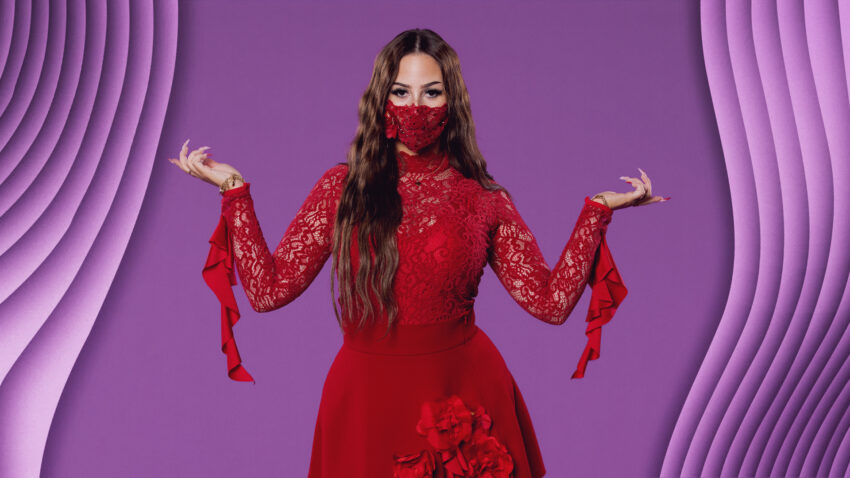
The Eurovision season has brought a wide variety of entries, and among them stands out Sweden, which has opted for a proposal with a strong stage presence and contemporary identity. The broadcaster SVT selected its representative through Melodifestivalen 2026, where Felicia Eriksson managed to win with her entry “My System”, securing her ticket to Vienna.
How has her journey to Eurovision been? What lies behind her musical proposal? How has she built a unique identity within the current music scene?
On this occasion, we review the musical career of FELICIA, the context of her candidacy, and her song. The Swedish representative at the Eurovision Song Contest 2026 will attempt to take her country to the top of the scoreboard with “My System”, an electro-pop entry that reflects her artistic evolution and consolidation in the music industry, in what will be Sweden’s 66th participation in the European contest.
This is FELICIA, her rural origins and the Fröken Snusk project
Felicia Eriksson, born on 5 October 2001 in Tullinge, is a Swedish artist whose career reflects a remarkable personal and professional evolution within the current music landscape. She grew up in a rural area of Stockholm, where she was influenced by the epadunk culture, a phenomenon linked to youth in rural regions. Before fully dedicating herself to music, she studied Business Administration and worked in various jobs.
Her rise to fame came in 2022 as the voice of the Fröken Snusk project, created by producer Rasmus Gozzi. Under an anonymous identity and wearing a pink balaclava, she achieved huge success with “Rid mig som en dalahäst”, which surpassed 20 million streams. Her provocative and direct style quickly resonated with a young audience.
In 2023 she consolidated her popularity with numerous releases, more than 120 concerts, and a strong presence on digital platforms, becoming one of the most streamed artists in Sweden. Her concept, based on epadunk—a mix of electronic music, techno-pop, and folk elements—went beyond music to become a cultural phenomenon.
In 2024 she took part in Melodifestivalen with “Unga & Fria”, achieving a strong impact despite not reaching the final. That same year she won Masked Singer Sverige, reinforcing her popularity, although she also faced controversy regarding her streaming numbers, which were ultimately dismissed. 2025 marked a turning point following her departure from the Fröken Snusk project, a situation that deeply affected her on a personal level. She later revealed her identity as the original voice and began a new solo phase, more authentic and personal.
Under the name Felicia, she signed with Warner Music and released songs such as “Black Widow”, “Sugar High” and “Hard”, as well as the EP My System (2026). Her renewed proposal blends pop, electronic music, and K-pop influences. In 2026 she achieved a decisive victory at Melodifestivalen with “My System”, which allowed her to represent Sweden at Eurovision.
This is “My System”, the proposal by FELICIA to represent Sweden at Eurovision 2026
After her victory at Melodifestivalen 2026, FELICIA represents Sweden at the Eurovision Song Contest 2026 with the song “My System”. The track has been composed by Felicia Eriksson herself together with Audun Agnar, Emily Harbakk, Julie Bergan, and Theresa Rex.
“My System” is a pop proposal with electronic elements entirely in English that expresses the inner struggle of someone trying to convince herself that she has moved on from a complicated relationship, but who in reality remains deeply attached.
During the week, the protagonist believes she has forgotten that relationship, but when the weekend arrives, all the feelings return strongly. It reflects an emotional addiction, because she “can’t get him out of her system.” Although that relationship hurts her, she admits that she cannot erase or block those feelings and cannot escape them.
Lyrics
English
I don’t even want you
No you don’t take up space
On any given Monday
I’m forgetting how you taste
I killed the whole idea of you
Been dancing on your grave
Cause I don’t even want you
Then Friday screams your name
Cause now you’re in my head, my heart, my body parts
You’re always coming back on the weekends
You’re in every touch
And thought – and every shot
No I can’t get you out of my system
No I can’t get you out of my system
Hate the morning after
Hate the way you make me feel
I am a disaster
I just need to fix myself for real
Cause now you’re in my head, my heart, my body parts
You’re always coming back on the weekends
You’re in every touch
And thought – and every shot
No I can’t get you out of my system
No I can’t get you out of my system
No I can’t get you out of my system
If I deleted all the memories of you and me
And barricaded my walls
If I encrypted all my feelings for security
It wouldn’t matter at all
Cause now you’re in my head, my heart, my body parts
You’re always coming back on the weekends
You’re in every touch
And thought – and every shot
No I can’t get you out of my system
No I can’t get you out of my system
Sweden at Eurovision: A Quick History
Sweden has participated in Eurovision since 1958 and is one of the most successful countries in the contest, with seven victories. The most recent came in 2023 with Loreen and «Tattoo», which marked her second personal win and consolidated the country’s position in the festival’s history.
Its national selection, Melodifestivalen, is one of the most widely followed and competitive formats in Europe. Throughout its history it has maintained great consistency, with only one semifinal elimination in 2010. In 2024, Marcus & Martinus finished 9th with 174 points.
In 2025, KAJ achieved 4th place with 321 points thanks to «Bara Bada Bastu», a festive and light-hearted entry with a strong cultural identity that went viral in several countries.