

Malta is preparing to become the epicentre of European children’s music. The Malta Fairs & Conventions Centre (MFCC) in Ta’ Qali (Malta) will host the Junior Eurovision Song Contest 2026 on Saturday, 24 October. The Mediterranean island is ready to welcome the 16 delegations that will compete for victory. Malta is once again taking charge of organising the European contest for the third time in its history.
The Eurovision stage will be filled with talent, excitement and music with the celebration of Junior Eurovision 2026. The 16 young participants will have the opportunity to defend their entries and fulfil one of their biggest dreams: representing their countries in front of viewers around the world. As it approaches its first quarter-century, the Junior Eurovision Song Contest will once again be held under the slogan “United By Music”, which will once more highlight the spirit of unity that defines the contest. On this occasion, with an added incentive: inviting us and making us part of the **great Maltese “festa”, where music, tolerance and diversity are an essential part of the show.
With the big event drawing ever closer, the time has come to focus on its protagonists and discover the details of each of the 16 entries that will compete to take home the coveted crystal microphone. For many of them, what began as a dream in front of the television is about to become a reality on the Junior Eurovision stage.
This time, it is the turn to discover the biography and professional career of Harry Georgiou, Cyprus’s representative at the Junior Eurovision Song Contest 2026. The young artist secured his ticket to Ta’ Qali after being internally selected by Cypriot broadcaster CyBC following an open call to all talents on the Mediterranean island. His selection opened the doors to the contest, where he will represent his country with «Who I Can Be».
How did his journey towards Junior Eurovision begin? What made him fall in love with music? What are his biggest dreams? And what is the meaning behind the song he will perform on the Ta’ Qali stage? Through his story, we get to know young Harry Georgiou, who is taking part in this 24th edition, more closely.
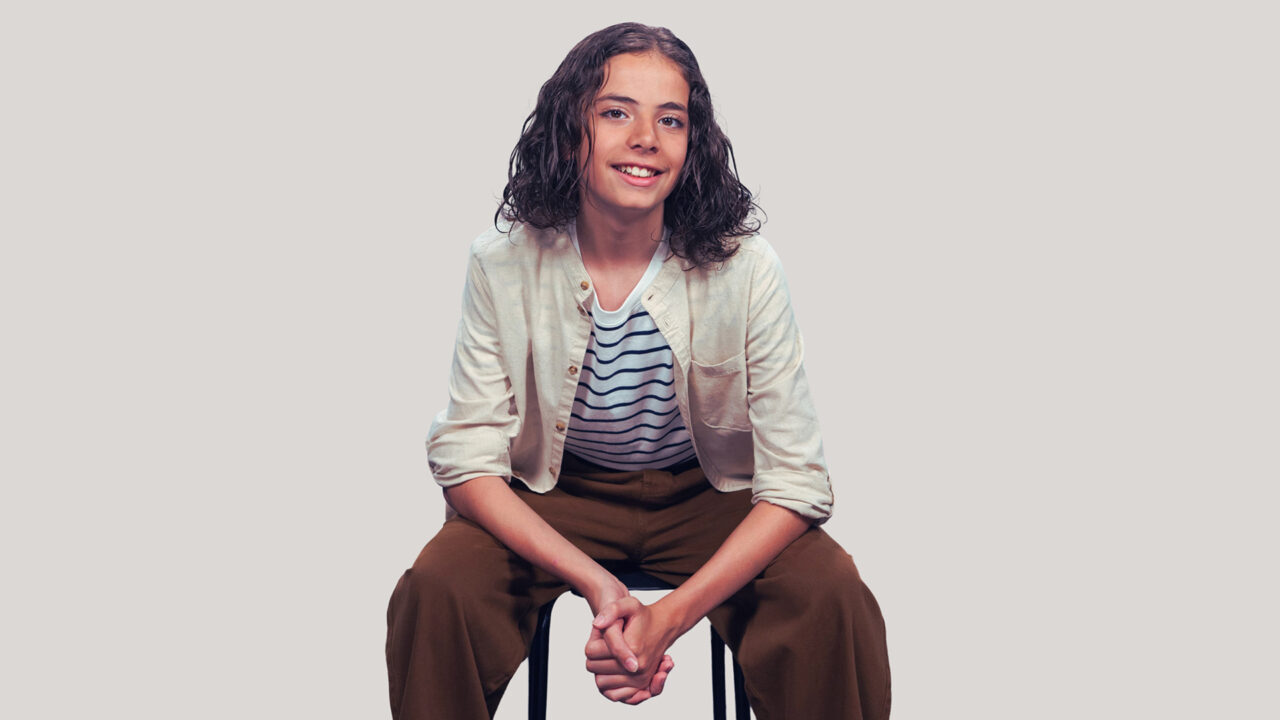
This is Harry Georgiou: when music and theatre find their voice
Harry Georgiou, at just 13 years old, is facing one of the most important chapters of an artistic career in 2026 that began long before his name appeared in the Eurovision world. Born and living in Enfield, north London (United Kingdom), the young British-Cypriot performer has developed intensive training in singing, acting and dance from a very young age.
Despite his young age, he can already boast of having worked professionally in two major West End productions in London, one of the most famous and lively areas of the British capital, particularly known for its theatres, musicals and shows.
Now, the experience gained on some of the most iconic stages of the British capital gives way to a completely different stage: the Junior Eurovision Song Contest 2026, where Harry Georgiou will represent Cyprus with «Who I Can Be».
His selection by broadcaster CyBC marks the culmination of an open process in which hundreds of young hopefuls took part. It also represents the arrival at Junior Eurovision of an artist with an unusual profile: a child who, before stepping onto the Eurovision stage, has already learned the demands of a professional theatrical production and of an environment as competitive as the West End.
The first steps of a young artist
Harry Georgiou’s relationship with music and the performing arts began at a very early age. From childhood, Harry Georgiou showed a particular interest in singing, acting and being on stage, interests that eventually developed into structured artistic training.
He currently continues his training at Platinum Performing Arts, a London academy where he works on different disciplines related to the performing arts, including singing, acting and dance. Multidisciplinary training is especially important in Harry Georgiou’s case, as much of his career has developed within musical theatre, a genre that requires combining dramatic performance, vocal technique, movement and the ability to perform in front of a live audience.
That learning has not been limited to the classroom. Harry Georgiou had the opportunity to transfer his training to the professional stage at a very early stage, something that has had a profound impact on his development as a performer.
His professional debut in the West End
The major breakthrough in Harry Georgiou’s career came in 2024, when he joined the cast of ‘Les Misérables’, one of the most renowned and longest-running musicals in London’s West End. This achievement was the result of numerous auditions and a great deal of effort from the young Cypriot.
During the 2024-2025 season, Harry Georgiou played the role of Gavroche, the young character who appears in some of the show’s most recognisable moments. His participation took place at the Sondheim Theatre, one of London’s historic venues. The production featured several child performers who alternated in the role, including Harry Georgiou, who spent nearly a year playing the part. For the young artist, that experience represented his professional West End debut.
This is particularly significant given his age. Performing regularly in a production on the scale of ‘Les Misérables’ means working within a professional team, maintaining the discipline required for rehearsals and performances, and meeting the demands of a large-scale production. For a child artist, that experience represents an extraordinarily demanding stage education.
From Gavroche to Michael Hobbs
After ‘Les Misérables’, Harry Georgiou continued to expand his professional experience with another major musical production: ‘Elf: The Musical’.
On this occasion, during the 2025-2026 Christmas season, the show was staged at London’s Aldwych Theatre, and Harry Georgiou joined the cast playing Michael Hobbs. The role was shared among several young performers — Ayrton English, Max Garlick, Harry Georgiou and Samuel Sturge — following the usual system of alternating child actors in this type of production. The production had a limited run, from late October 2025 until 3 January 2026.
In addition, his participation in the theatrical production allowed Harry Georgiou to continue working in a professional environment. In this way, in just two seasons, he appeared in two major West End productions and gained experience in different styles and performance registers.
It is precisely this combination of disciplines that best defines Harry Georgiou’s artistic profile. He is not simply a singer who has begun acting, nor solely a child actor who has moved into music. His training is built around the concept of a musical theatre performer, where voice, acting and movement form part of the same stage tool.
In addition to his theatrical experience, he has also received recognition in the field of vocal competitions. Harry Georgiou recently received a Best Vocal Performance award at West End Calling, a British national competition featuring young performers from different parts of the United Kingdom. The recognition came before his arrival on the Eurovision stage and represents another indicator of the development of his abilities as a singer.
Harry Georgiou and his stage experience
If there is one element that distinguishes Harry Georgiou, it is his stage experience. Many young Junior Eurovision participants usually develop their first musical experiences through competitions, television, social media, music academies or local performances. In contrast, Harry Georgiou arrives at the European contest after having worked in professional West End productions.
This means that he is already familiar with some of the fundamental aspects of live performance: concentration before going on stage, the need to portray a character in front of hundreds of spectators, coordination with other artists, working with technical and creative teams, and the importance of maintaining a consistent level of performance.
Nevertheless, Junior Eurovision presents a different challenge from theatre. In a musical, the performer forms part of a longer story and benefits from the dramatic development of the entire show. At the children’s contest, Harry Georgiou will have to condense his performance into a single televised appearance and allow the audience to discover his artistic personality in just a few minutes. That is where his theatrical experience will meet the particular demands of the Eurovision format.
At the same time, in June 2025, Harry Georgiou achieved fifth place in the amateur category of the UDC urban dance competition, organised by the Unified DANCE CO school. This recognition marked a further step in his journey within urban dance, highlighting his dedication, technical development and artistic commitment in the competitive field.
Beyond his work within the world of musicals, Harry Georgiou maintains a deep passion for musicals, an interest that forms an essential part of his artistic side and which he particularly enjoys whenever he has the opportunity to step onto a stage or simply share his voice.
His repertoire also extends to major songs from musical cinema, among which «Never Enough» from ‘The Greatest Showman’ stands out, one of his favourite songs because of its intensity, sensitivity and vocal demands. Likewise, he has a particular fondness for the music of ‘Wicked’, whose songs he performs enthusiastically, demonstrating that his connection with musicals goes far beyond his professional commitments. For Harry Georgiou, performing these songs provides an opportunity to explore different emotions, styles and characters through music, keeping alive a passion that complements and enriches his career as a performer.
The road to Junior Eurovision
The leap from the West End to Junior Eurovision came in 2026, when Cyprus’s public broadcaster once again decided to use an open audition process to choose its representative. Ultimately, Harry Georgiou was selected as Cyprus’s representative.
The decision to choose Harry Georgiou also carries a particular significance, as he is a young artist who develops his artistic life in London. His selection highlights the international dimension of the Greek Cypriot community and the possibility that young people culturally connected to Cyprus, even if they pursue their training and careers in other countries, can represent the country in international competitions. In his case, his connection to Cyprus is combined with a career built primarily in the United Kingdom.
London as his school and Cyprus as his identity
Harry Georgiou’s story also reflects an increasingly visible characteristic of Cypriot representation: the Greek Cypriot diaspora.
The young singer has developed artistically in London, one of the world’s major capitals of musical theatre, but he will represent Cyprus at the Junior Eurovision Song Contest 2026. His career brings together two different cultural spaces: Cypriot tradition and identity and the professional environment of the British performing arts.
His training in London has allowed him to access high-level professional opportunities from a very young age. From now on, he has the opportunity to bring everything he has learned to an international audience. In this sense, Junior Eurovision is not a starting point for Harry Georgiou, but a new chapter in a career that is already underway.
Therefore, Harry Georgiou is embarking on a new experience, even for an artist accustomed to performing in front of large audiences. For the first time, his performance will not be part of a musical, but of an international music competition.
This is «Who I Can Be», Harry Georgiou’s entry to represent Cyprus at Junior Eurovision 2026
Harry Georgiou will represent Cyprus at the Junior Eurovision Song Contest 2026 with the song «Who I Can Be». The composition was created by an international team with extensive Eurovision experience. Laurell Barker, Anna-Klara Folin, Nathalie Brydolf, Victoria Chalkitis and Thomas Stengaard are credited as the songwriters of the music and lyrics. All of this was carried out under the production, mixing and mastering of Thomas Stengaard.
The latter, for example, has taken part in Eurovision compositions such as «Only Teardrops», winner of the Eurovision Song Contest 2013, as well as being part of the teams behind the Cypriot entries «El Diablo» (2021) and «Break A Broken Heart» (2023). Laurell Barker also took part in the composition of Cyprus’s entry in 2021.
Its music video brought together a large team of professionals from the fields of music, acting, directing and audiovisual production. The project visually expands the message of the song through a story inspired by ‘Pinocchio’.
For this, it featured Varnavas Kyriazis and a young cast made up of Amelie Philippides, Nicolas Clark and Theofanis Sergiou. The video was directed by Bodega, with Fotinos Bakrisioris as director of photography.
Meanwhile, Thelma Cassoulidou was responsible for production and costume design, while Natalia Michael took charge of production direction and performance direction. The appearance of the protagonists in the music video was handled by Elena Mavroyiorka, responsible for hairstyling, and Maria Charalambous, who was in charge of make-up.
The creative team was completed by Andria Christou as assistant choreographer and creative assistant, Christina Tselepou as vocal coach, and Athena Lianou, who was responsible for studio vocal training.
The Cypriot entry combines Greek and English. The artist presents us with a message of freedom, identity and self-discovery. The song is told from the perspective of a young person who wants to leave behind the limitations and expectations imposed on him by other people in order to find his own path.
In the verses in Greek, the protagonist asks to be heard and expresses his desire to dream, discover the world and make his own decisions, alongside the need to grow with autonomy.
One of the central elements of the song is the contrast between the words that constantly remind him of what he “should” or “should not” do and his decision to finally say “I” in his own voice. In this way, the song presents growth as a process in which a person learns to distinguish between other people’s expectations and their own desires.
The chorus, performed in English, concentrates this idea: “I’m gonna be who I can be.” The singer states that he wants to shine freely, open doors, move forward without limits and show the world who he can become. The image of flying reinforces this sense of liberation and overcoming barriers.
In the final part, the message becomes even more symbolic: learning to spread one’s own wings, listen to the heart and wanting to reach for the stars. All of this represents the decision to dare to pursue one’s dreams and believe in oneself.
Lyrics of «Who I Can Be» by Harry Georgiou, Cyprus’s entry for Junior Eurovision 2026
Greek / English
Thelo na m’ akouseis, echo
polla na po
Den thelo me ton fovo panta
na zo
Ase me na do, na oneirefto
Thelo ki ego ton dromo mou
na vro
Diarkos mou thymizeis ta ochi
ta prepei, ta mi
Ma irthe i ora na po ena
“me”, me diki mou foni
I’m gonna be who I can be
I’m gonna shine wild and free
Every door I got the key
I’ll be reaching endlessly
I’m gonna fly let the world see
Who I-I-I can be
Thelo na matho monos mou ta giati
Mi charazeis panta ti grammi
Ase me na do,
na oneirefto
Thelo ki ego ton kosmo mou
na vro
Diarkos mou thymizeis ta ochi
ta prepei, ta mi
Ma irthe i ora na po ena
“me”, me diki mou foni
I’m gonna be who I can be
I’m gonna shine wild and free
Every door I got the key
I’ll be reaching endlessly
I’m gonna fly let the world see
Who I-I-I can be
Mathaino n’ anoigo ta ftera
mou
Akouo tin kardia mou
Thelo na ftaso sta asteria
psila
English
I want you to listen to me,
I have so much to say.
I don’t want to always
live in fear.
Let me see, let me dream,
I want to find my own path too.
You keep reminding me of all the “no’s,”
the “musts” and the “don’ts.”
But now it’s time for me to say “me,”
with a voice of my own.
I’m gonna be who I can be,
I’m gonna shine wild and free.
Every door, I got the key,
I’ll be reaching endlessly.
I’m gonna fly, let the world see
Who I-I-I can be.
I want to learn the reasons why
on my own.
Don’t always draw the line for me.
Let me see, let me dream,
I want to find my own world too.
You keep reminding me of all the “no’s,”
the “musts” and the “don’ts.”
But now it’s time for me to say “me,”
with a voice of my own.
I’m gonna be who I can be,
I’m gonna shine wild and free.
Every door, I got the key,
I’ll be reaching endlessly.
I’m gonna fly, let the world see
Who I-I-I can be.
I’m learning to spread my wings,
I listen to my heart.
I want to reach
the stars up high.
Enjoy all the songs from Junior Eurovision 2026 in ESCplus’ Spotify playlist:
Cyprus at the Junior Eurovision Song Contest
Cyprus made its debut at the Junior Eurovision Song Contest in Copenhagen 2003, becoming one of the founding countries of the contest. This debut came with young artist Theodora Rafti, who, with her song «Mia Efhi», finished in a modest 14th place with 16 points, although it served as the first step in the country’s history in the children’s contest.
A year later, at Lillehammer 2004, the Mediterranean country began to shine thanks to Marios Tofi and his energetic song «Oneira», which achieved 8th place with 61 points, one of the country’s best results to date. This achievement would be repeated two years later, in Bucharest 2006, when Luis Panagiotou & Christina Christofi performed «Agoria Koritsia», also reaching 8th place, consolidating Cyprus’s potential in the contest.
In Hasselt 2005, the country was forced to withdraw at the last minute after being disqualified over an alleged case of plagiarism involving the song «Tsirko». Even so, public broadcaster CyBC remained involved by voting in that edition, demonstrating its commitment to the contest.
The most special moment came in Limassol 2008, when Cyprus had the honour of hosting the children’s contest. The home entry was performed by Elena Mannouri & Charis Savva, who entertained the host audience with «Gioupi Gia!», achieving 10th place with 46 points.
After that period of continuity, Cyprus was absent from the contest between 2010 and 2013. However, the country returned strongly in Malta 2014. The talented Sophia Patsalides, internally selected, won over the audience with «I Pio Omorfi Mera», finishing in 9th place with 69 points, the highest score in the country’s history.
Despite the positive impression left by that result, Cyprus did not take part in Bulgaria 2015. However, in Valletta 2016, it returned with George Michaelides and his energetic «Dance Floor», but the results were not favourable: he finished in 16th place. In Tbilisi 2017, history repeated itself with Nicole Nicolaou and «I Wanna Be A Star», which finished last with 45 points. Those two years marked a setback, and the broadcaster decided to withdraw again.
However, in Madrid 2024, Cyprus returned to the European stage with renewed enthusiasm. Young Maria Pissarides performed «Crystal Waters», restoring excitement among the country’s fans. With 60 points, she achieved 13th place.
Meanwhile, in Tbilisi 2025, the Cypriot entry was performed by the duo made up of Rafaella Panteli and Christos Georgiou. With their song «AWAY», they reached 16th place with 50 points. They finished last with the national juries, while climbing to 11th place in the viewers’ vote.