

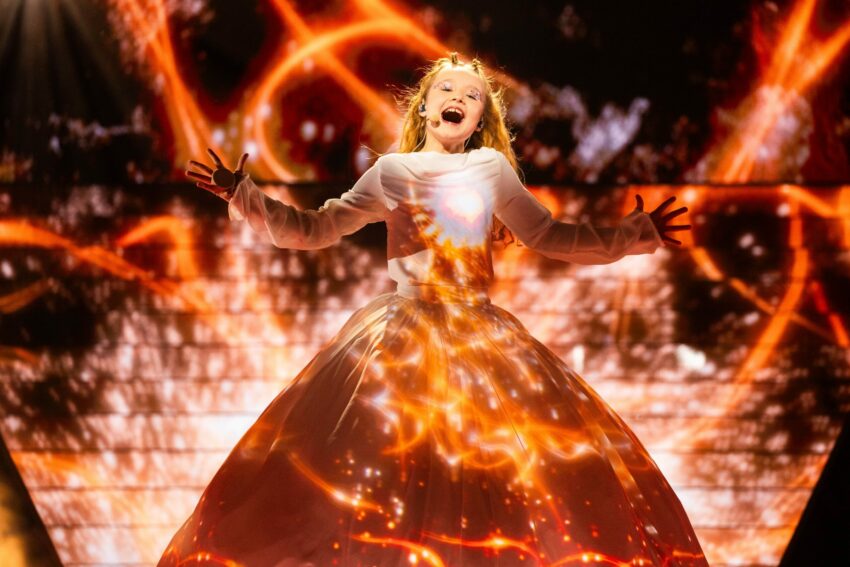
Ahead of this year’s Junior Eurovision Song Contest, and following the selection of Wiktor Sas as Poland’s representative at the 2026 contest — the first artist confirmed for this 24th edition — Polish broadcaster TVP has confirmed its participation in Junior Eurovision 2027.
In May, the public broadcaster closed the call for applications for the new season of ‘The Voice Kids Poland’. It will be the 10th season of the successful talent show and the second directly linked to Junior Eurovision as a national selection, not counting 2025, when finalist Marianna Kłos was internally selected to compete in Tbilisi (Georgia). In 2026, Wiktor Sas won the show and will represent Poland at the Junior Eurovision Song Contest on Saturday 24 October at the Malta Fairs & Conventions Centre in Ta’ Qali (Malta).
Young artists aged between 8 and 13, with the permission of their parents or legal guardians, were able to apply from 1 May through the show’s official casting website, voicecasting.pl, during the application window set out in the rules.
The rules of the new season of ‘The Voice Kids Poland’ already set a date for the choice of Poland’s representative at Junior Eurovision 2027: the live final on Saturday 8 May 2027, subject to scheduling changes. Recordings began in August 2026, and the anniversary season will premiere on TVP2 in spring 2027, hosted by Paulina Chylewska and Michalina Sosna.
For 2027, the coaching panel has been reshuffled. In August, TVP announced that, for the first time in the show’s history, there will be four coaches and four teams: Cleo, who represented Poland at the Eurovision Song Contest 2014 alongside Donatan, Mikołaj Maciej Trybulec “Tribbs”, the returning duo Tomson & Baron and Sara James, winner of the fourth season of the show and runner-up at Junior Eurovision 2021. Blanka, Poland’s representative at Eurovision 2023, leaves the panel. Each coach will lead 12 participants, and four young singers, one per team, will reach the final.
The key points of the ‘The Voice Kids Poland’ call for applications
Those interested in taking part in the talent show had to meet a series of requirements, especially regarding age: they must be at least 8 years old on 14 August 2026 and under 14 on 31 December 2026. Their legal representative must give written consent for their participation.
The participant’s guardian had to provide valid photo identification, a document that may be required at any point in the process.
Applications were submitted through a web form, to which candidates had to attach recordings of two covers: one in Polish and one in English (as MP4 or MOV files). It was also compulsory to include a scanned copy of the image-rights consent form signed by the legal guardian.
In the videos, candidates could sing over a backing track, accompany themselves on acoustic guitar or piano (only one instrument was allowed) or sing a cappella. The recording could not be edited or go through any sound processing, and no tool altering the voice was allowed.
Once the call closed, the production team assessed the applicants to decide who would take part in the televised shows. According to the rules published in May, the participants who get through the qualifying rounds are coached and judged by renowned Polish artists — three in the original rules, now four following TVP’s announcement in August.
The format keeps its traditional structure of Blind Auditions, Battles, Sing-offs and the final. In its 10th season, ‘The Voice Kids Poland’ will once again look for the best child voice in Poland and, therefore, for its representative at Junior Eurovision.
In 2025, broadcaster TVP made a radical change to its selection format for the children’s contest. After dropping its usual national final, ‘Szansa na Sukces’, it announced it would use ‘The Voice Kids Poland’ from 2026. However, for Tbilisi 2025 it also decided to internally select Marianna Kłos from among the finalists of the eighth season of the talent show who met the age rule, since the winner, Zofia Wójcik, was over the limit. The rules of the TV competition have now adopted some of the Junior Eurovision requirements.
For Ta’ Qali 2026, the chosen artist was Wiktor Sas, crowned the best child voice in Poland this year after receiving the most votes from viewers.
How does ‘The Voice Kids Poland’ work? This is how Poland will choose its representative for Junior Eurovision 2027
The rules of the 10th season of ‘The Voice Kids Poland’, published in May, set out the recording dates, the selection process and the voting system that will decide Poland’s representative at Junior Eurovision 2027. Some figures have since changed: with four coaches, TVP now plans teams of 12 and four finalists, so the numbers below are those of the rules as originally published.
Phase 1: Production pre-selection (initial eliminations) | Not broadcast
This preliminary stage aims to select around 90 participants for the Blind Audition recordings. The producer reserves the right to increase the number of candidates.
The selection of artists draws on production scouting, recommendations from the broadcaster and from music authorities, local cultural centres, organisers of song festivals in Poland and vocal workshops.
Although the videos submitted during the call are assessed, the producers may also invite participants to in-person auditions.
The selected candidates were informed on 15 July 2026. Until then, all applicants committed not to take part in any other TV production.
Phase 2: Blind Auditions
The rules provide for three coaches forming three teams of 18 artists each (54 participants in total), although the producer reserves the right to increase the number of participants. All pre-selected artists who meet the other requirements in the rules take part in this stage.
Over four days of Blind Auditions, each coach chooses their team, judging only the participant’s voice. As usual, the coaches do not see the participant until they decide to invite them onto their team. If more than one coach picks the same participant, the young artist chooses. If no coach picks a candidate, they are eliminated from the competition.
The Blind Auditions were recorded in Warsaw from 17 to 20 August 2026, after rehearsals between 14 and 16 August.
Phase 3: Battles
The Battles run over three episodes, in which the number of artists is cut from 54 to 18 under the original rules. First, participants are split into trios and receive vocal and stage coaching from their coach, a process scheduled between 31 August and 6 September 2026.
Each trio (six per coach) performs the same song. After the performance, the coach decides which participant goes through. In the end, each coach keeps six candidates.
The recordings and music rehearsals for the Battles were scheduled for 16 to 19 September 2026.
Phase 4: Sing-offs
The Sing-off takes place immediately after each coach’s team has completed its six Battles.
During the Sing-off, the six participants take turns to perform the song they sang in the Blind Auditions. After the six performances, each coach decides which three contestants advance to the final, for a total of nine finalists under the original rules.
Phase 5: Grand final
The finalists return to the stage for a grand final in two parts, one pre-recorded and one live.
The first part is due to be recorded on 11 November 2026, with the finalists performing their versions of well-known songs. Their performances are assessed by the coaches, and each coach picks their superfinalist. The rules also allow the producer to bring into the superfinal an additional participant: a former contestant from a previous season of the show.
The second part of the grand final will be broadcast live on 8 May 2027. In the superfinal, viewers vote by SMS to decide which contestant receives the most votes and therefore becomes the winner.
Alongside the title of winner of ‘The Voice Kids Poland’, the winner will receive the offer of a record deal with Universal Music Polska and will represent Poland at the Junior Eurovision Song Contest 2027. The producer, broadcaster TVP or the show’s sponsor may also award additional prizes to participants.
The rules also note that the organiser of the Junior Eurovision Song Contest may cancel the contest at any time. In that case, the Junior Eurovision prize would not apply, nor could it be carried over to later years, and the winner would not be entitled to any compensation.
The full rules of the 10th season of ‘The Voice Kids Poland’ (in Polish) have been published (in Polish) on TVP’s website.