

The Maltese festa continues! The Malta Fairs & Conventions Centre (MFCC) in Ta’ Qali, Malta continues to welcome the young talents from the 16 countries taking part in the Junior Eurovision Song Contest 2026 as they take to the stage for their individual rehearsals on this second day of preparations in Malta.
On Monday 19 October, individual rehearsals for the Junior Eurovision Song Contest 2026 continued. The Mediterranean island is in the middle of several busy days of work on the impressive stage set up at the Malta Fairs & Conventions Centre (MFCC).
With the 24th edition drawing ever closer, the young performers are continuing to prepare and fine-tune their performances ahead of the big event, which will take place on Saturday 24 October at 21:00 CEST.
All the participating artists have been working hard in their home countries to develop their performances. However, rehearsing on the contest stage is a key opportunity to see their staging concepts come to life and adjust anything that needs improving before the live show.
How do the Junior Eurovision 2026 rehearsals work?
As in previous years, each artist taking part in the Junior Eurovision Song Contest 2026 has two individual rehearsal sessions, during which they can perform their entry several times. This stage of the rehearsal process will continue until Wednesday 21 October.
During the first individual rehearsals, each artist has 30 minutes to complete as many run-throughs of their performance as possible. They can adjust and improve the staging and camera work following the stand-in rehearsals held the previous week. These are usually the most demanding rehearsals, as they mark the performers’ first experience on the actual contest stage.
The second individual rehearsals will follow, with each country receiving 20 minutes to work on any remaining details and ensure that everything is ready for the dress rehearsals. This second round is usually more straightforward, allowing delegations to fine-tune their performances with small adjustments. The organisers will publish a compilation of these rehearsals, featuring the television camera footage, on YouTube at the end of the day.
On Friday 23 October, the main dress rehearsal, known as the jury show, will take place. As well as offering a performance as close as possible to the live broadcast, it is when the professional juries from each country will cast their votes, accounting for 50% of the final result.
Which countries are rehearsing on the second day of Junior Eurovision 2026 (19 October 2026)?
For the second consecutive edition, the European Broadcasting Union (EBU) has decided that Junior Eurovision 2026 will not have accredited press access in Malta, either in person or online. As a result, journalists will not have access to the rehearsals for the Junior Eurovision Song Contest 2026.
The contest organisers are providing the schedules for each rehearsal day at the beginning of the session. Rehearsals have continued throughout the morning, with a break at midday.
Here is the rehearsal schedule for the second day, Monday 19 October 2026:
Malta Calling | A closer look at the second day of rehearsals
On Monday 19 October, it was the turn of the remaining eight countries to take to the stage at the Malta Fairs & Conventions Centre (MFCC) in Ta’ Qali, Malta. Below, you can find a brief description of each country’s rehearsal and a selection of images shared on Junior Eurovision’s social media channels.
- Malta: Beppe Caruana – «Blue Bird»
- Italy: Matteo Trullu – «Che Cos’è l’Amore?»
- Ukraine: Erika Kolesnichenko – «NOT A LULLABY»
- North Macedonia: Ana Stojanoska – «Idnata Jas»
- Ireland: Caleb Kirwan & Naomi Gribben – «Níos Láidre»
- Albania: Eslin Kurti – «Kërce Me Mua»
- Georgia: Davit Lomidze – «Sun on the Rooftops»
- Spain: Lucas Paulano – «Cuore Bello (Te Quiero, Te Quiero)»
Malta: Beppe Caruana – «Blue Bird»
The performance by Beppe Caruana, representing Malta at the Junior Eurovision Song Contest 2026, features dynamic, colourful and theatrical staging that combines the fantasy of a journey with a visual style inspired by adventure and exploration. The young singer wears a long-sleeved white shirt, high-waisted beige trousers and dark braces, completing his outfit with black shoes and thick-framed glasses.
This classic, slightly retro-inspired outfit gives him a youthful and expressive look, reinforcing the character of a curious young dreamer.
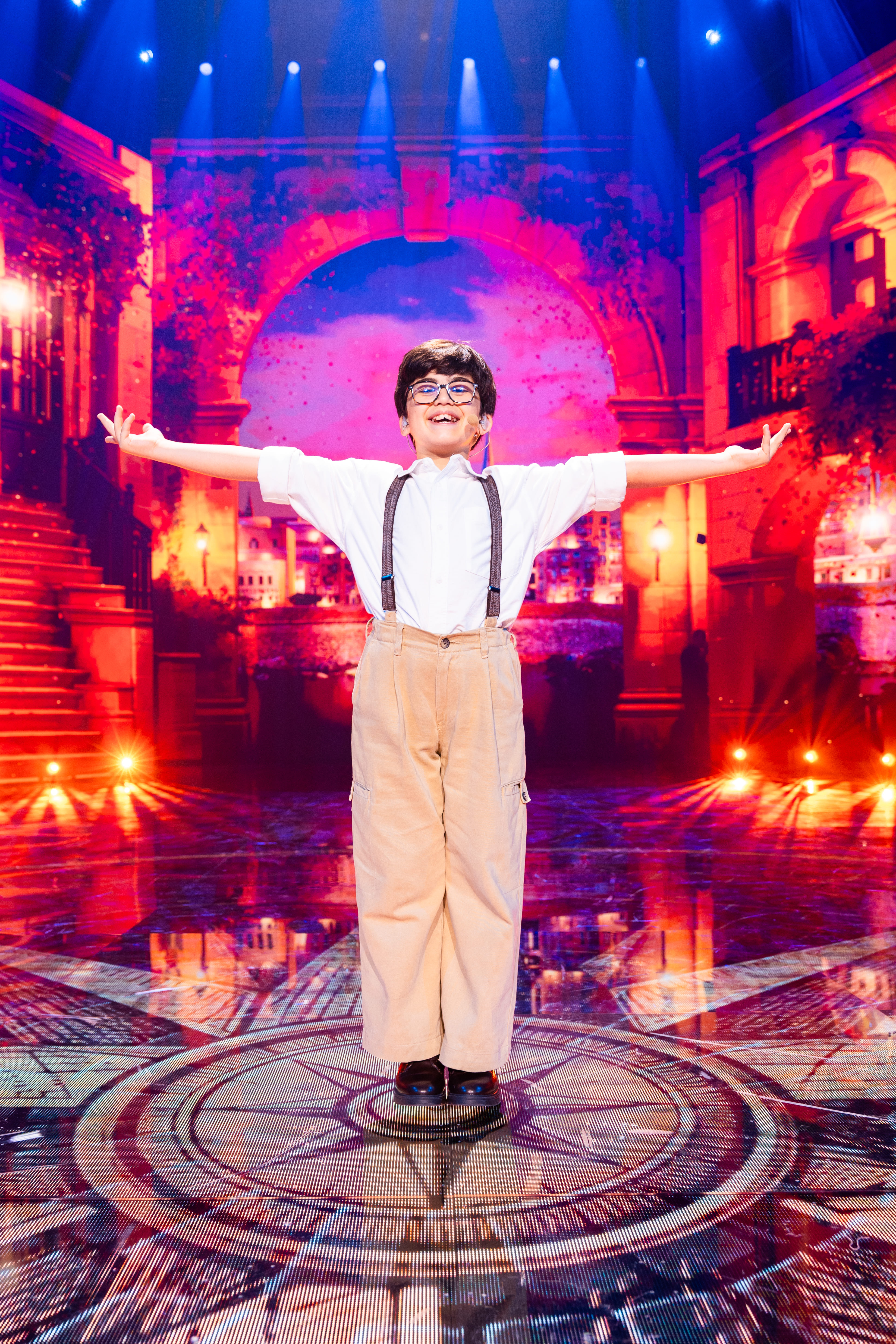
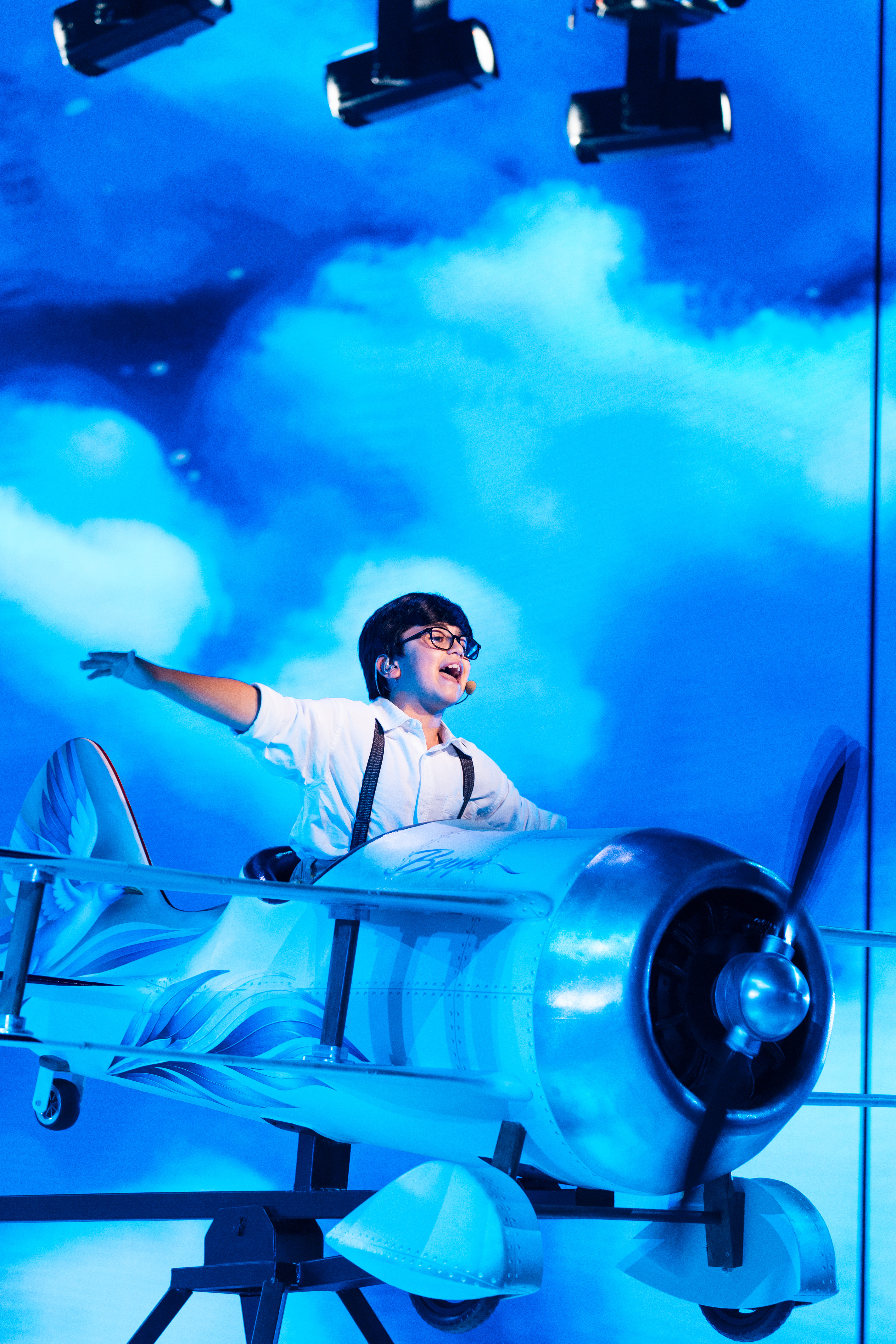
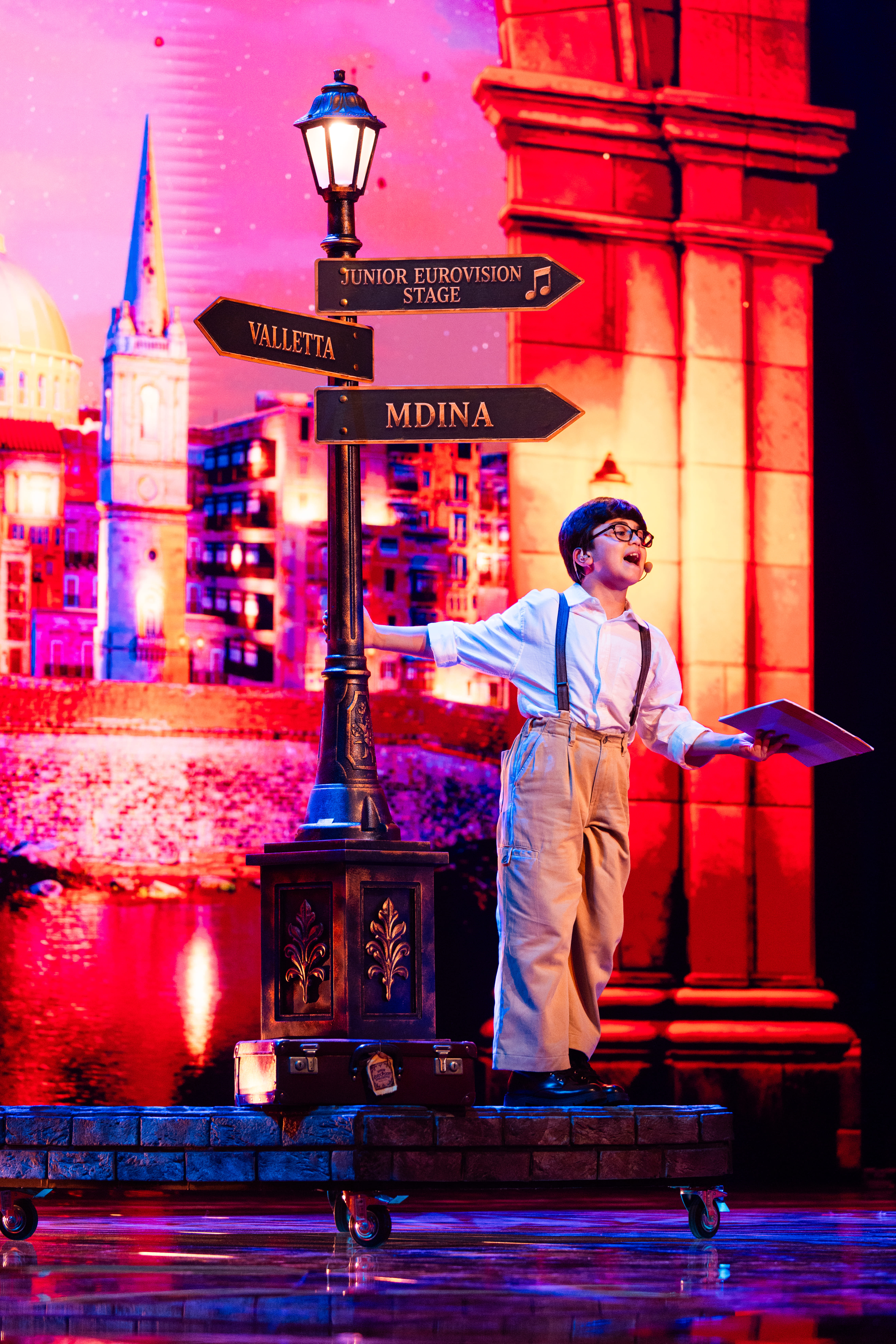
The visuals projected onto the screens play a key role in telling the story. One scene features a city with historic architecture, monumental buildings and references to Maltese landmarks, including Valletta and Mdina. Shades of pink, red and orange create a warm, magical atmosphere. In another sequence, the background changes to a deep blue sky filled with clouds, evoking the feeling of flying and discovering new horizons.
Beppe Caruana is joined by several young dancers who play an active part in the performance. They wear coordinated outfits, with white shirts, light-coloured trousers and traditional-style details. Their movements, gestures and facial expressions bring energy, chemistry and a storytelling element that adds to the performance.
Among the most notable stage props are an ornamental streetlamp with directional signs, a travel suitcase and a prop aeroplane. There is a clear resemblance to the Spanish performance by Sandra Valero at Junior Eurovision 2023 in Nice. These objects reinforce the idea of travel, adventure and discovery, turning the stage into an imaginative setting.
The lighting makes an important contribution to the visual impact. Strong reds and magentas contrast with the electric blues and cyan tones of the flying sequence. The colour changes accompany the different scenes, creating depth, energy and contrast.
Italy: Matteo Trullu – «Che Cos’è l’Amore?»
The performance by Matteo Trullu, representing Italy at the Junior Eurovision Song Contest 2026, stands out for its elegant, emotional and visually striking staging, bringing together music, lighting and dance to create an immersive atmosphere.
Matteo Trullu wears an all-black outfit consisting of trousers, a T-shirt and a jacket decorated with small sparkling details that reflect the stage lights. The look adds sophistication and personality while maintaining a modern, youthful style. The female dancer, meanwhile, wears a classically inspired white costume, with a short flowing skirt, long sleeves and shimmering details around the neckline. The contrast between their costumes strengthens the visual connection between the two performers.
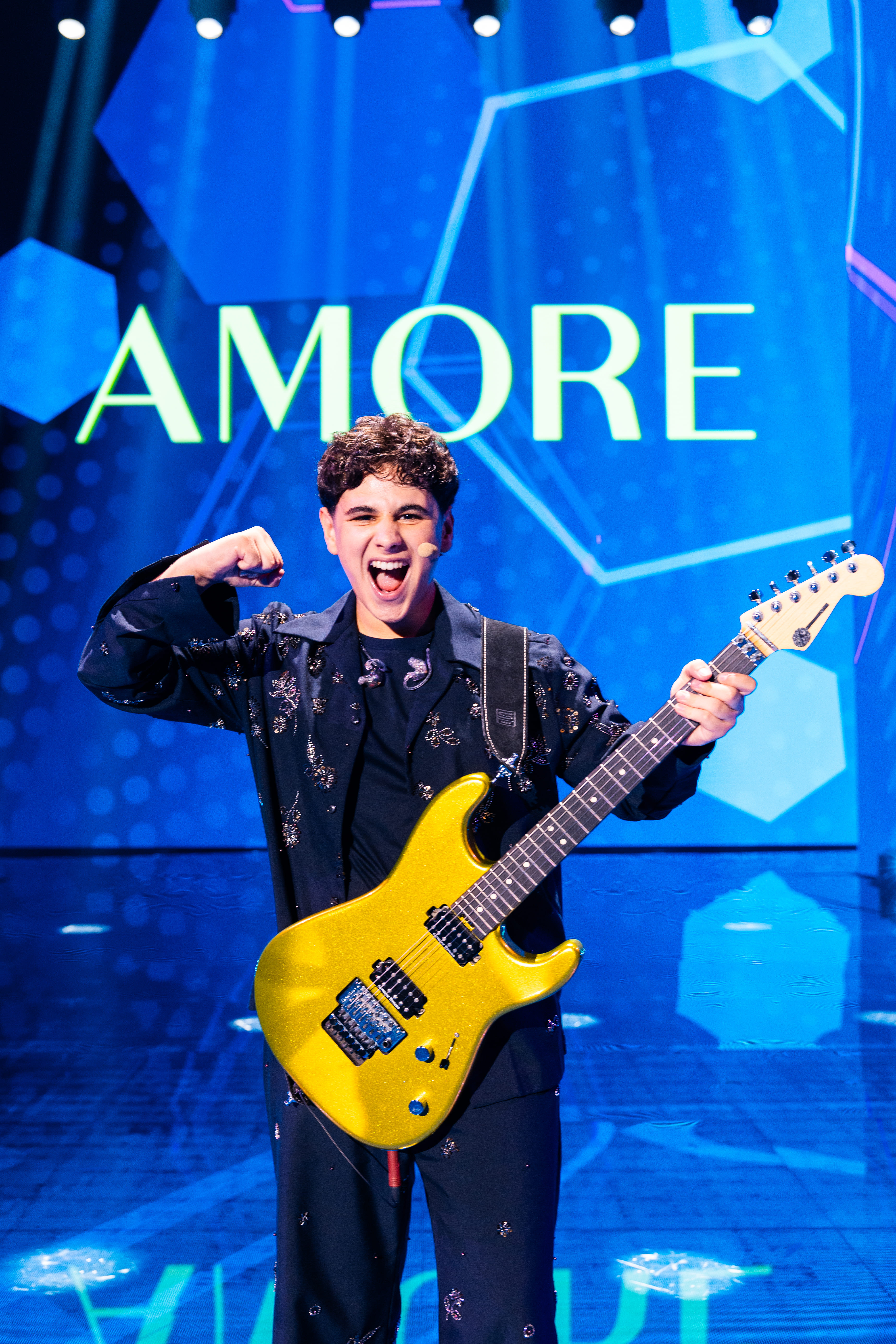
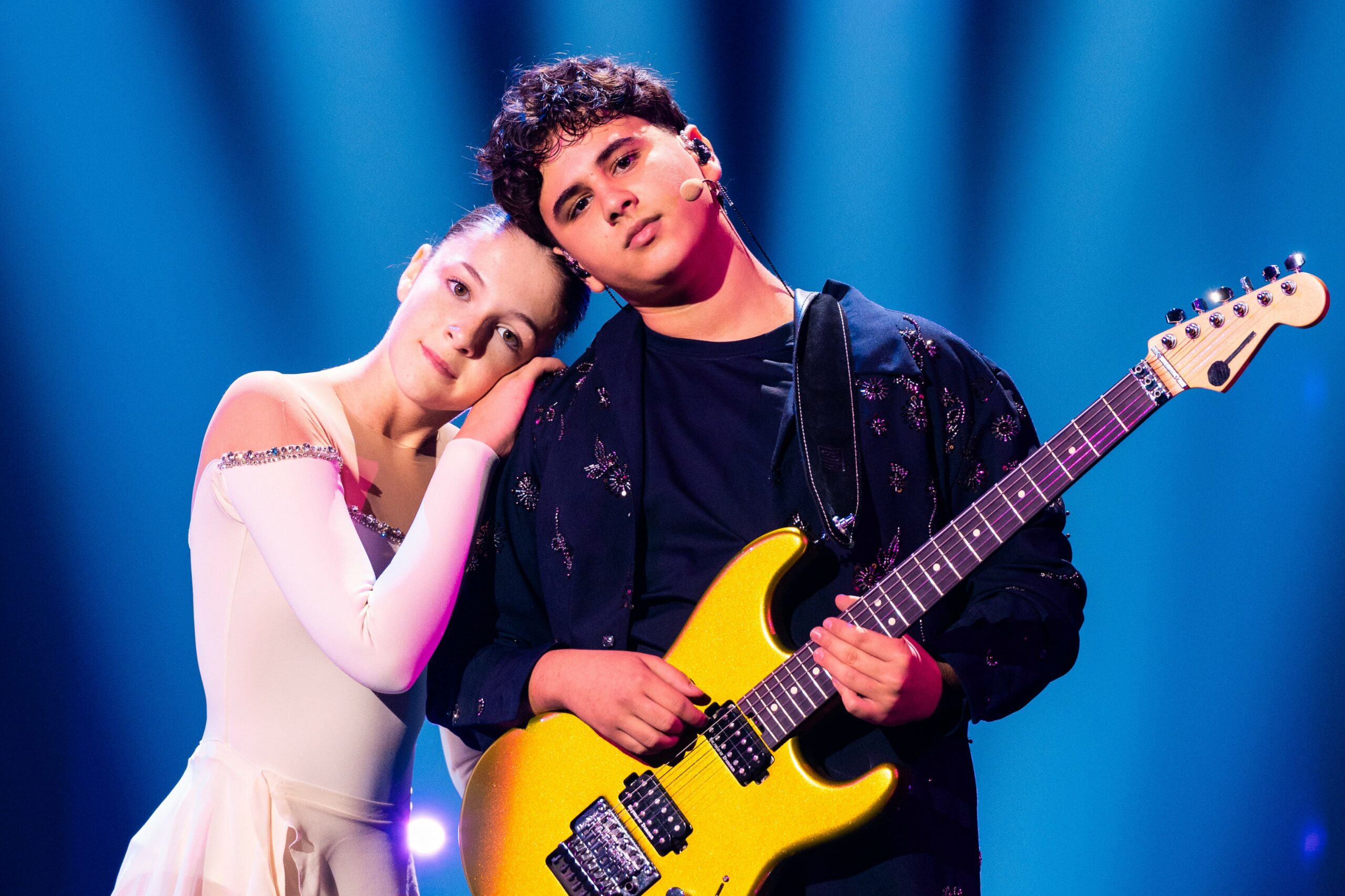
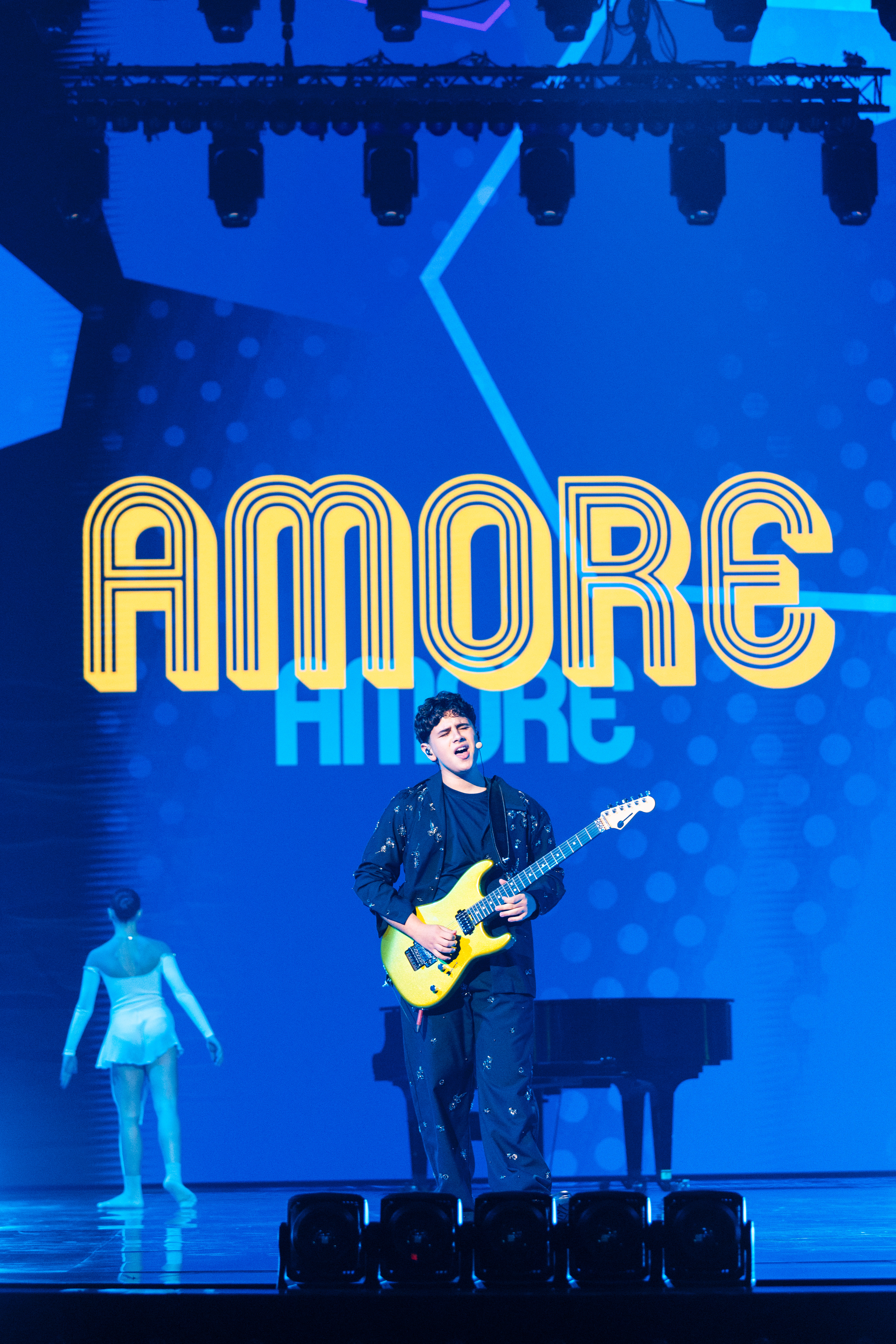
The main instrument is a shiny gold electric guitar, which stands out against Matteo Trullu’s dark clothing and becomes a central part of his performance. A black grand piano also appears on stage, adding elegance and suggesting a more intimate, expressive musical atmosphere. Matteo Trullu also uses a headset microphone, allowing him to sing while playing the guitar.
The screen visuals display the word “AMORE” in large yellow letters with a concentric-line design, set against a blue background featuring geometric shapes and illuminated patterns. This imagery reinforces the artistic and emotional nature of the performance.
The lighting is mainly based on blue and cyan tones, combined with white spotlights and flashes of violet. Vertical beams of light create depth and highlight the performers, while reflections on the stage floor enhance the visual effect.
Finally, the dancer brings delicacy and expression through ballet-inspired movements. Her presence adds a narrative and emotional element that complements the musical performance, creating a balanced and captivating act.
Ukraine: Erika Kolesnichenko – «NOT A LULLABY»
The performance by Erika Kolesnichenko, representing Ukraine at the Junior Eurovision Song Contest 2026, features striking, colourful and futuristic staging, combining extravagant costumes, intense lighting and energetic choreography. The performance creates a fantastical, surreal atmosphere in which all the visual elements help reinforce its identity.
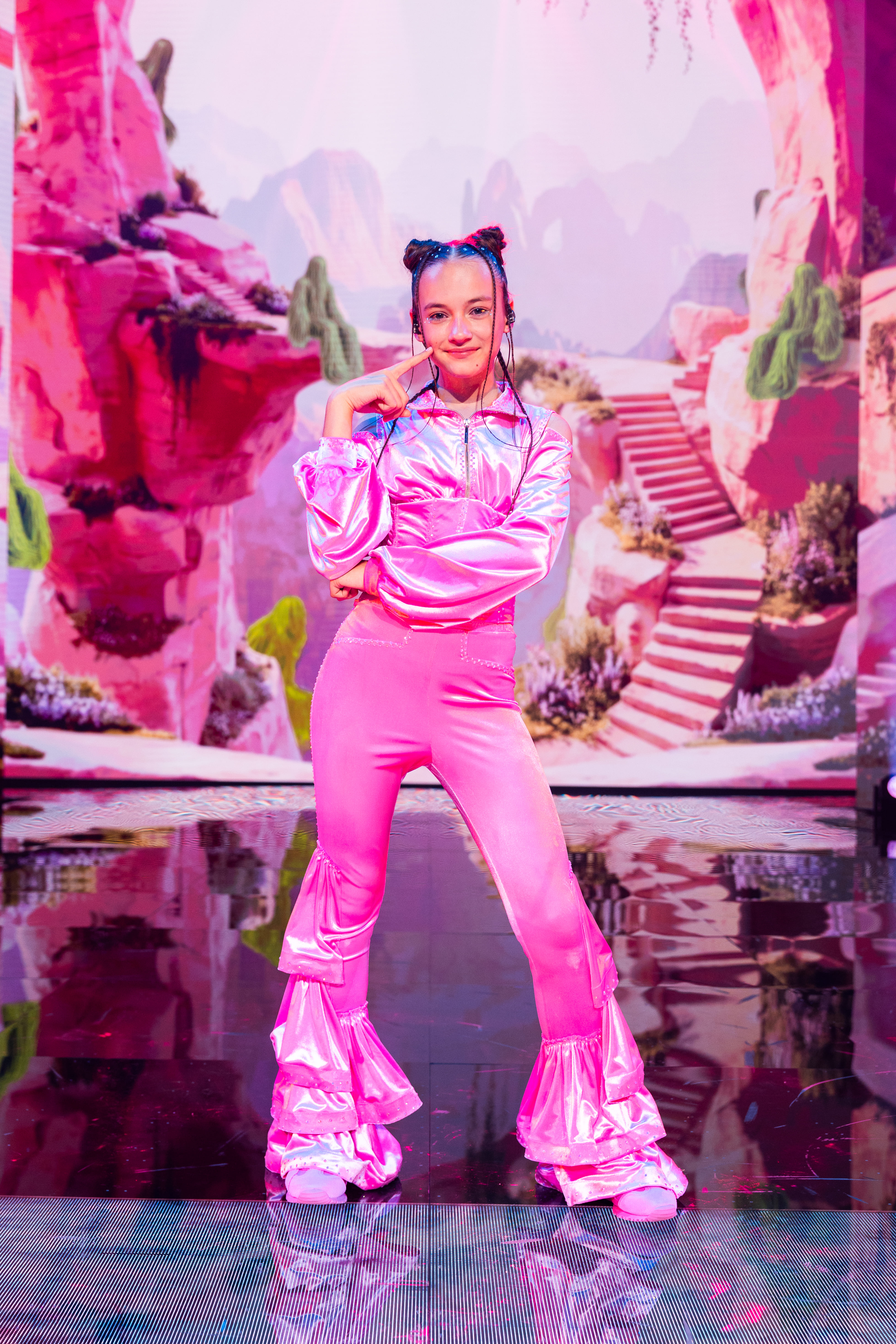
The singer wears a bright fuchsia-pink outfit with a shiny satin finish, featuring a jacket with puffed sleeves and exposed shoulders, a fitted lower section and matching boots. The fabric reflects the stage lights, creating pink, lilac and blue highlights. Her hairstyle, with two small buns, thin braids and sparkling accessories, completes a modern and distinctive look.
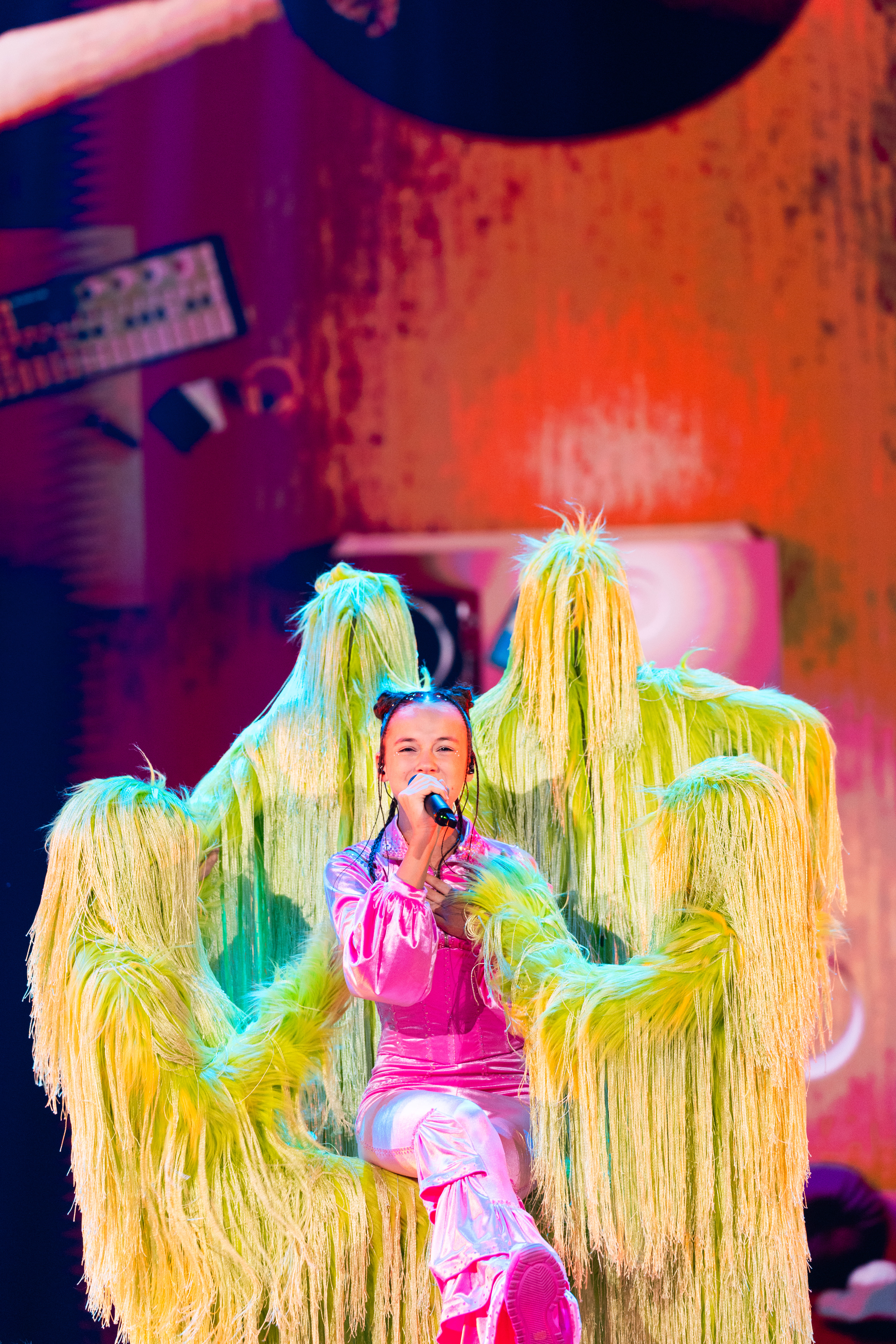
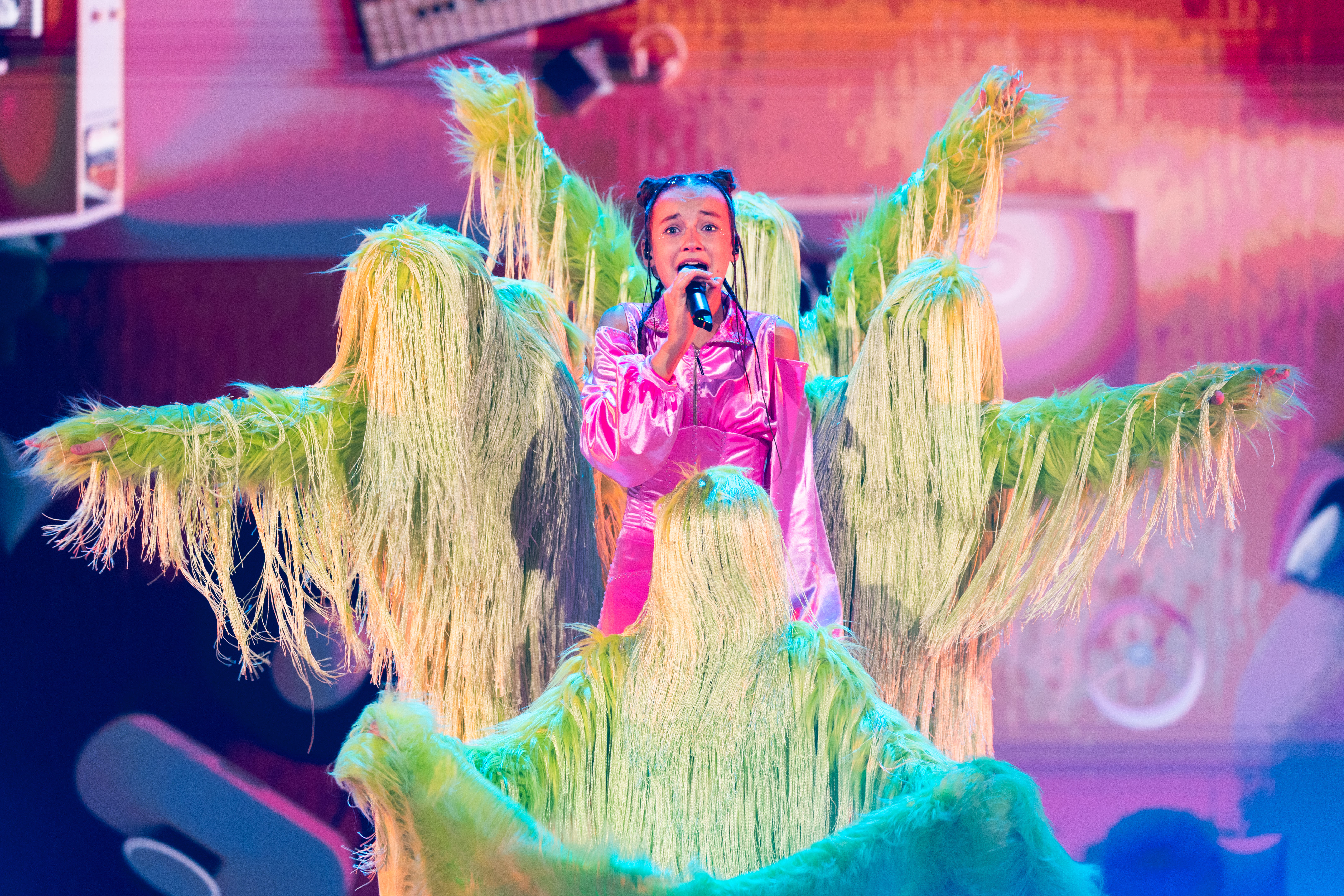
The dancers wear particularly eye-catching costumes, made up of long fibres in fluorescent yellow, lime green and turquoise that cover their bodies and hide their faces. They resemble fantasy creatures or beings from another planet. As they move, the fibres add volume and energy to the choreography, making the dancers an essential part of the staging.
The lighting combines magenta, pink, orange and electric blue, creating strong contrasts with the fluorescent colours of the costumes. The background features abstract projections and textures that reinforce the digital, futuristic aesthetic.
In terms of the performance, Erika remains centre stage thanks to her expressions and gestures, while the dancers surround her and create changing visual formations. Erika Kolesnichenko, representing Ukraine, presents striking, colourful and futuristic staging, combining extravagant costumes, intense lighting and energetic choreography. The performance creates a fantastical, surreal atmosphere in which all the visual elements help reinforce its identity.
The singer wears a bright fuchsia-pink outfit with a shiny satin finish, featuring a jacket with puffed sleeves and exposed shoulders, a fitted lower section and matching boots. The fabric reflects the stage lights, creating pink, lilac and blue highlights. Her hairstyle, with two small buns, thin braids and sparkling accessories, completes a modern and distinctive look.
The dancers wear particularly eye-catching costumes, made up of long fibres in fluorescent yellow, lime green and turquoise that cover their bodies and hide their faces. They resemble fantasy creatures or beings from another planet. As they move, the fibres add volume and energy to the choreography, making the dancers an essential part of the staging.
The lighting combines magenta, pink, orange and electric blue, creating strong contrasts with the fluorescent colours of the costumes. The background features abstract projections and textures that reinforce the digital, futuristic aesthetic.
In terms of the performance, Erika remains centre stage thanks to her expressions and gestures, while the dancers surround her and create changing visual formations.
North Macedonia: Ana Stojanoska – «Idnata Jas»
The rehearsal by Ana Stojanoska, representing North Macedonia at the Junior Eurovision Song Contest 2026, stands out for its dynamic and visually striking staging, bringing together costumes, lighting and graphic effects to create a performance full of energy and personality.
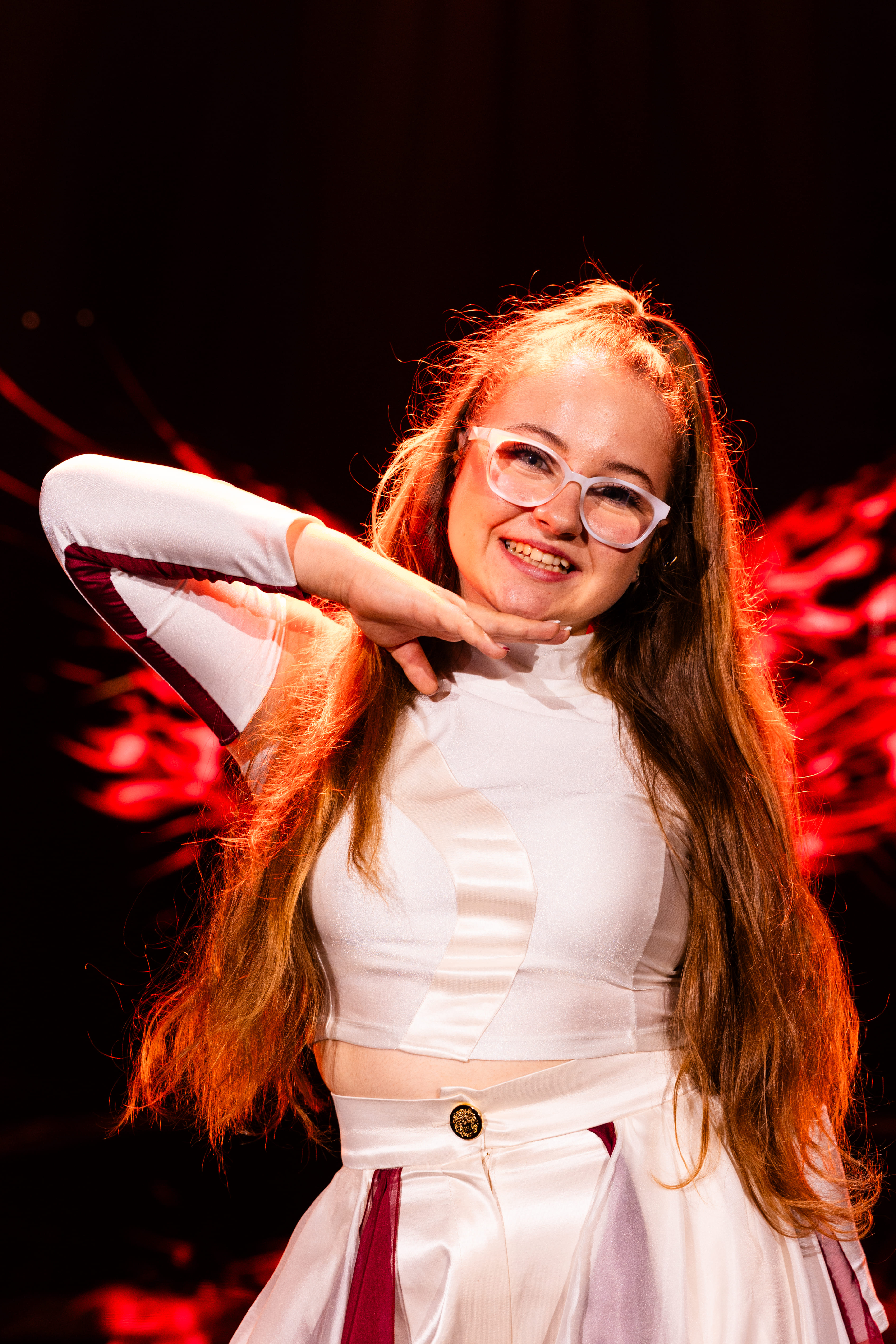
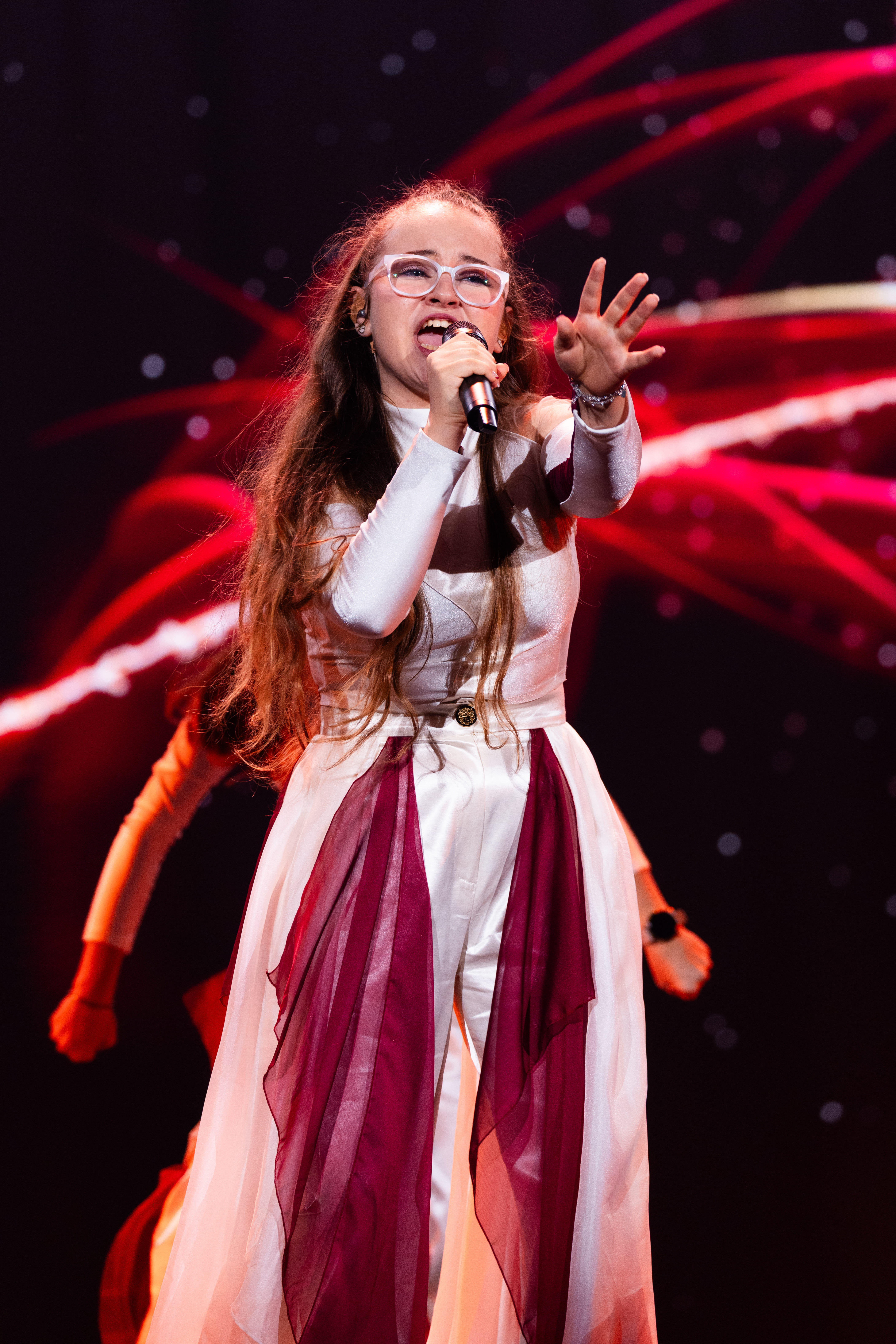
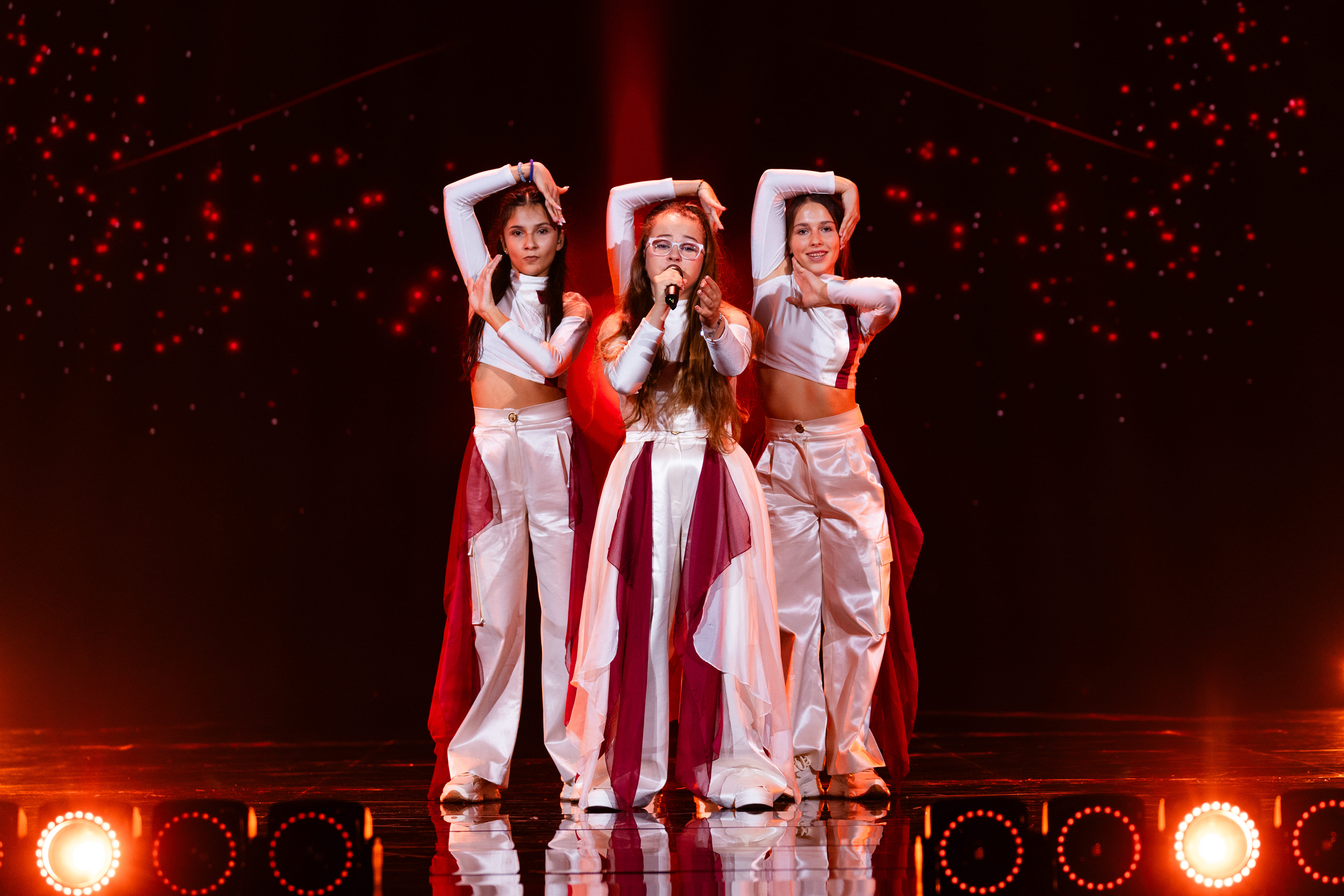
The costumes use white as their main colour, with futuristic, sportswear-inspired designs. Ana wears a fitted long-sleeved top, with satin panels and burgundy details, paired with wide white trousers and an overskirt made from lightweight, translucent fabrics. Her accompanying dancers wear coordinated outfits with satin trousers, cropped tops and long pieces of red fabric that add movement to the choreography. The contrast between white and burgundy reinforces the visual identity of the entry and helps every movement stand out on stage.
The lighting plays a key role in the rehearsal. Red and orange tones dominate much of the staging, creating an intense, dramatic atmosphere. These colours are combined with blue beams of light falling vertically from the ceiling, adding depth and contrast. Reddish backlighting outlines the silhouettes of the performers and highlights the movement of their hair and costumes.
As for the visuals, the screens show flowing, organic red abstract shapes that resemble flames or streams of energy. The dark background allows these elements to stand out, turning the stage into an immersive setting.
Ana Stojanoska remains at the centre of the performance, holding a microphone, while her dancers perform coordinated movements and geometric poses. The glossy floor reflects the lights and performers, increasing the visual impact of a performance that combines strength, elegance and energy.
Ireland: Caleb Kirwan & Naomi Gribben – «Níos Láidre»
The performance by Caleb Kirwan & Naomi Gribben, representing Ireland at the Junior Eurovision Song Contest 2026, features modern, dynamic and fantasy-filled staging, bringing together music, dance and visual effects to create a youthful, energetic show.
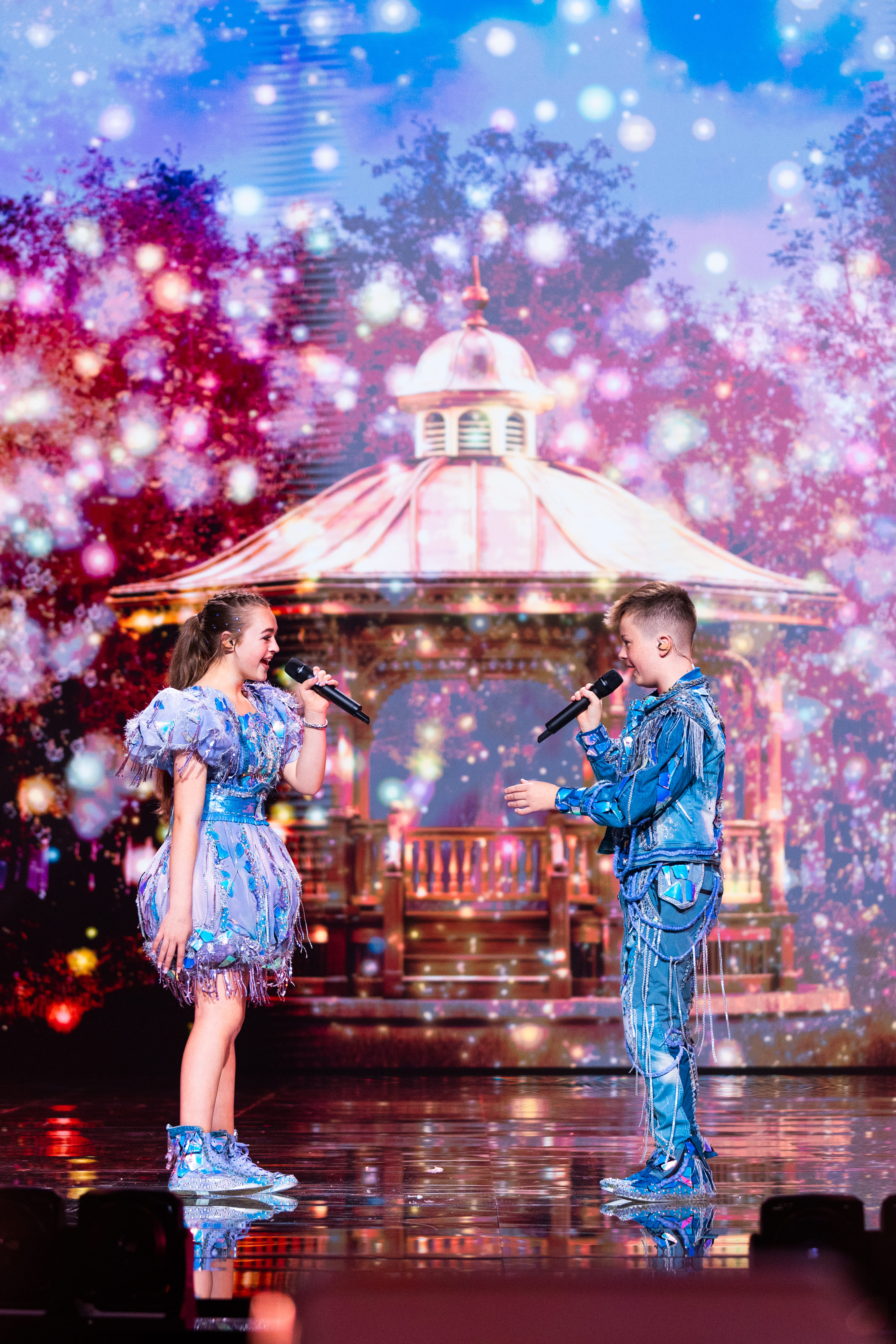
The two singers wear coordinated blue and silver outfits, with plenty of sparkling details, metallic fabrics and fringes that add movement. Naomi Gribben wears a short futuristic-style dress, with voluminous sleeves, feather decorations and matching boots. Caleb Kirwan wears a striking jacket and trousers decorated with strips and reflective details. Both outfits create a modern, bold and distinctly theatrical look.
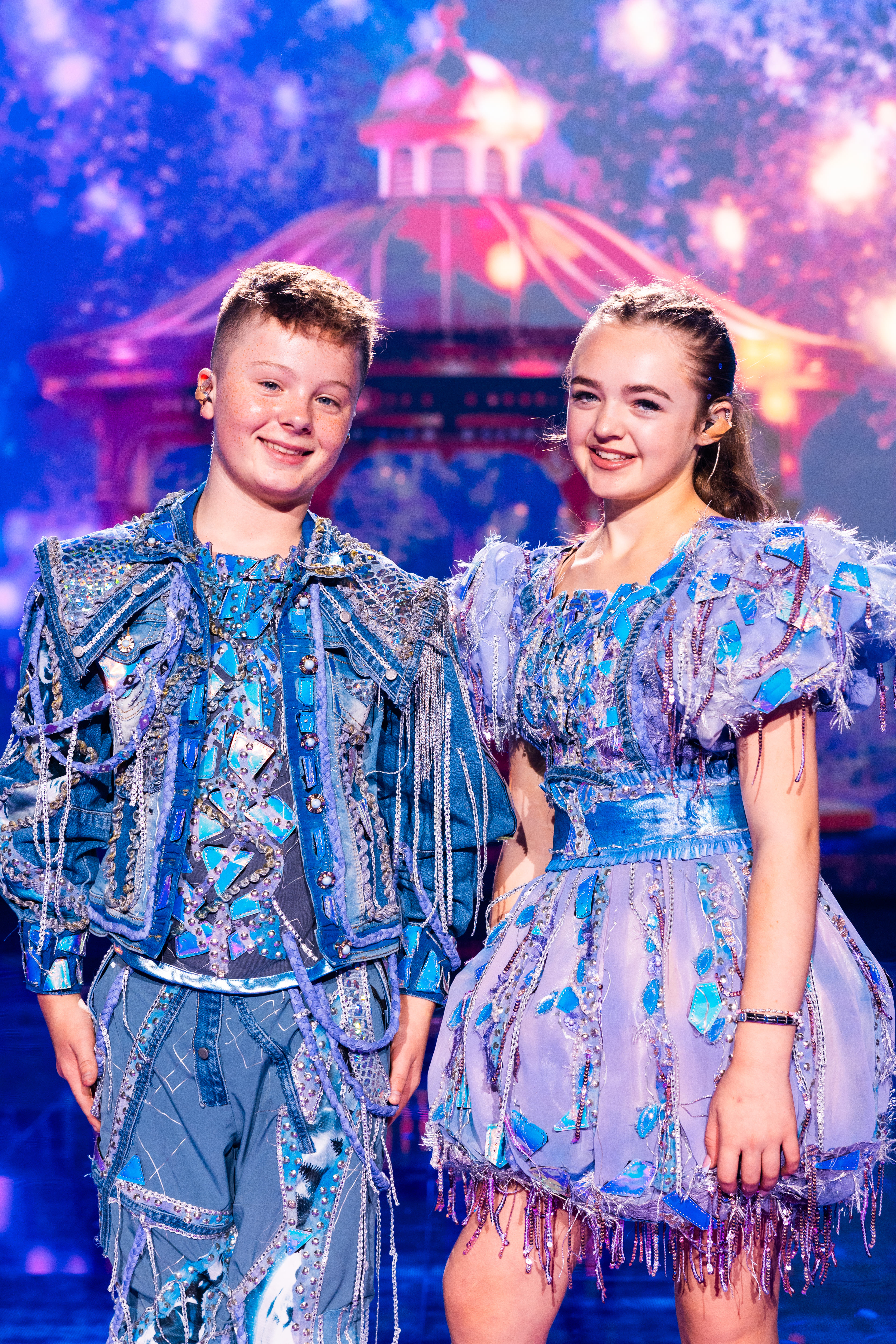
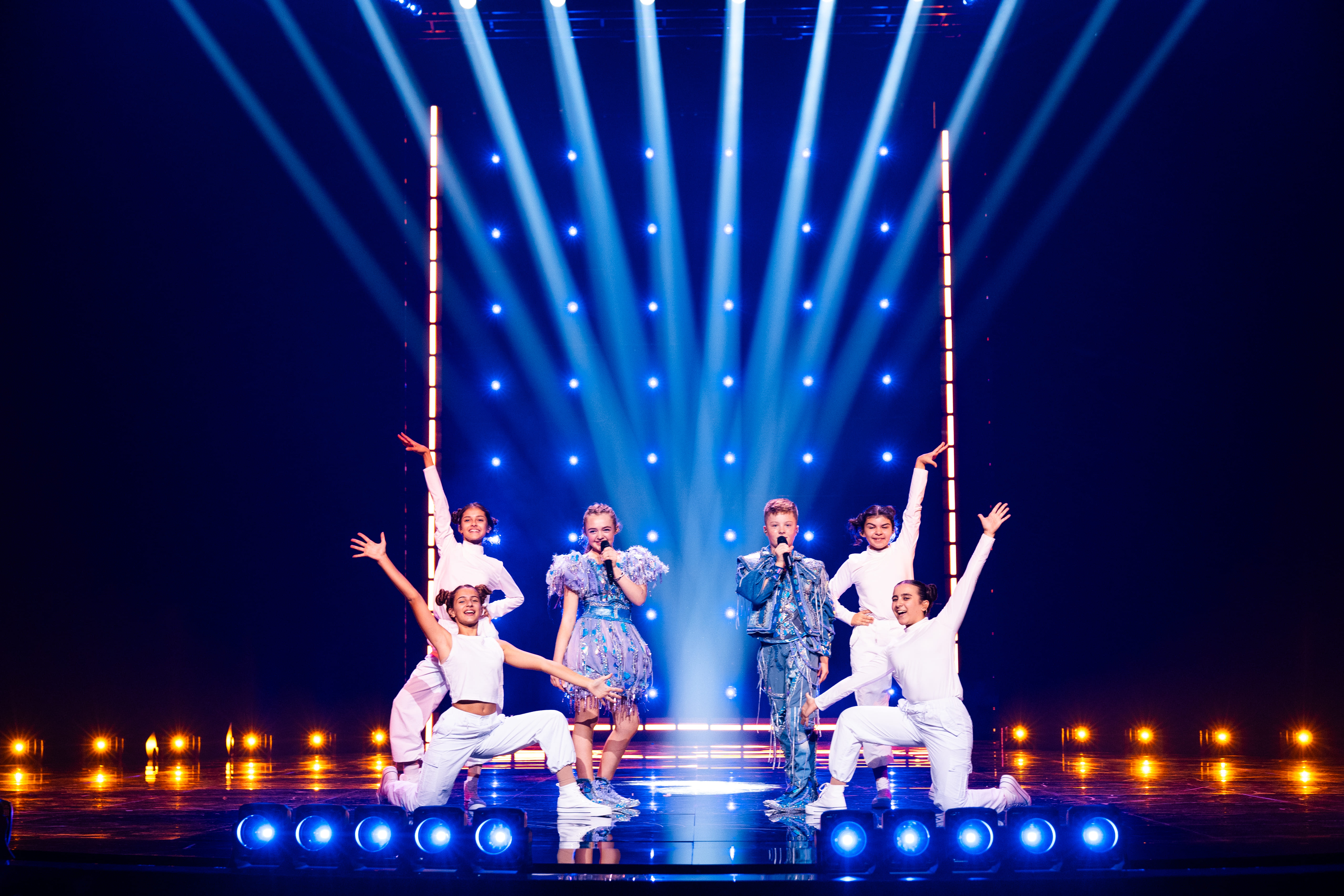
Lighting plays a key role. Strong blue and white beams shine down from the ceiling and converge on the artists, creating depth and highlighting the main performers. On the floor, blue and amber spotlights add contrast, while side and vertical lighting frame the stage and make the setting feel even bigger.
The screens show a traditional-style bandstand in a fantasy setting, surrounded by trees and sparkling lights. Glowing particles, pink, violet and turquoise lighting, along with bokeh effects, create a magical, almost fairytale-like atmosphere. The black, reflective floor mirrors the colours and silhouettes, adding to the overall visual effect.
Caleb Kirwan & Naomi Gribben perform the song using handheld microphones, interacting with each other through energetic movements and coordinated gestures. They are also joined by four dancers dressed in white, who perform acrobatic poses, arm extensions and symmetrical formations around them. Their costumes contrast with the blue outfits worn by the lead singers, helping to keep the attention on Caleb and Naomi.
Overall, it is a colourful and carefully designed performance, combining fantasy, youthful energy and futuristic styling to keep the audience engaged.
Albania: Eslin Kurti – «Kërce Me Mua»
The performance by Eslin Kurti, representing Albania at the Junior Eurovision Song Contest 2026, embraces a futuristic aesthetic full of energy, colour and references to the world of electronic music. The staging combines a technological look with a youthful, carefree attitude, creating a visually striking performance.
The costume is one of the standout elements. Eslin wears a metallic silver outfit with blue and pink reflections, consisting of a cropped jacket with structured shoulders, decorated with studs and sparkling details, and wide futuristic-style trousers. Under the jacket, she wears a silver top, while accessories and blue gloves complete the look. The reflective finish of the clothes catches the colours of the stage lighting, reinforcing the feeling of being in a science-fiction setting.
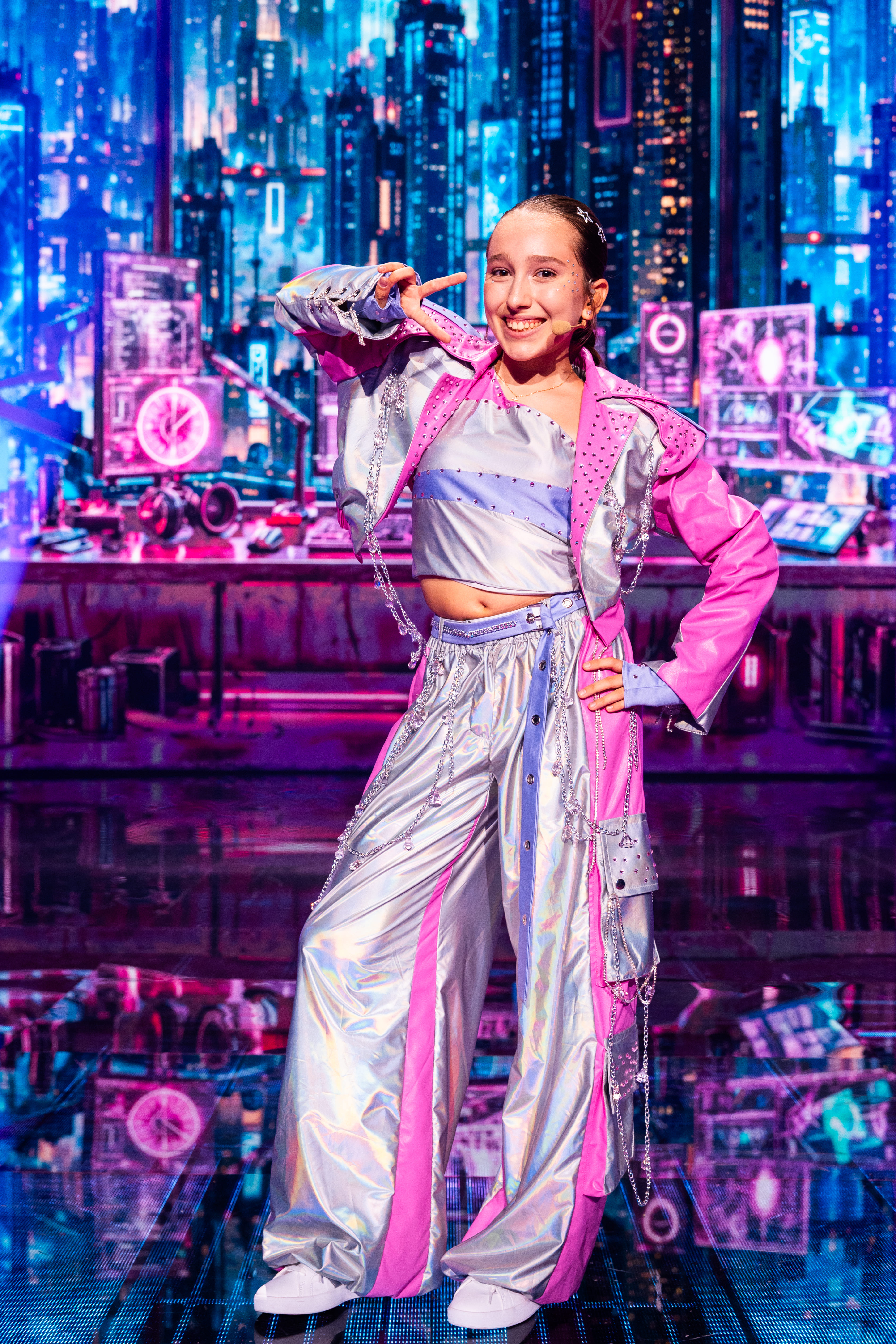
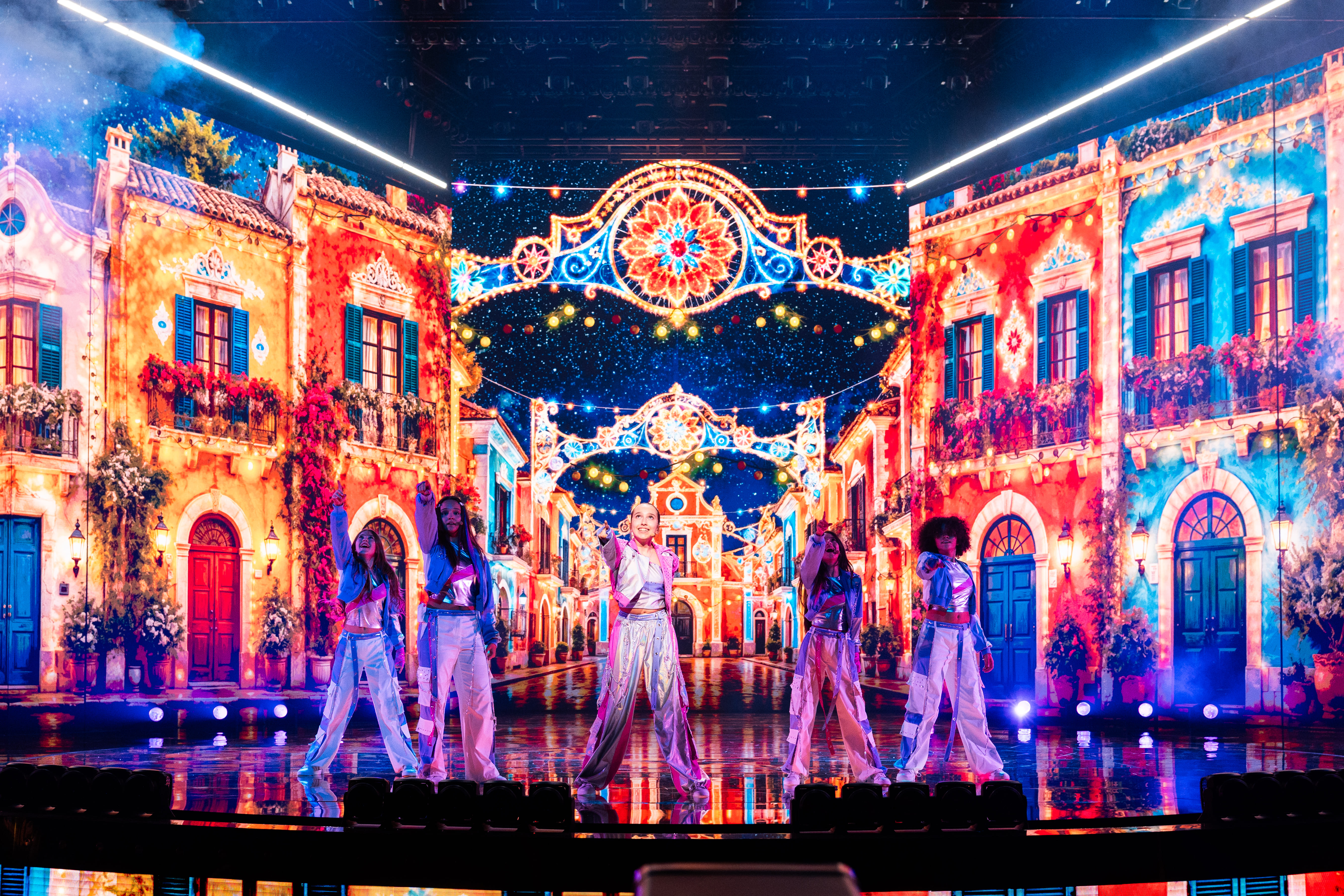
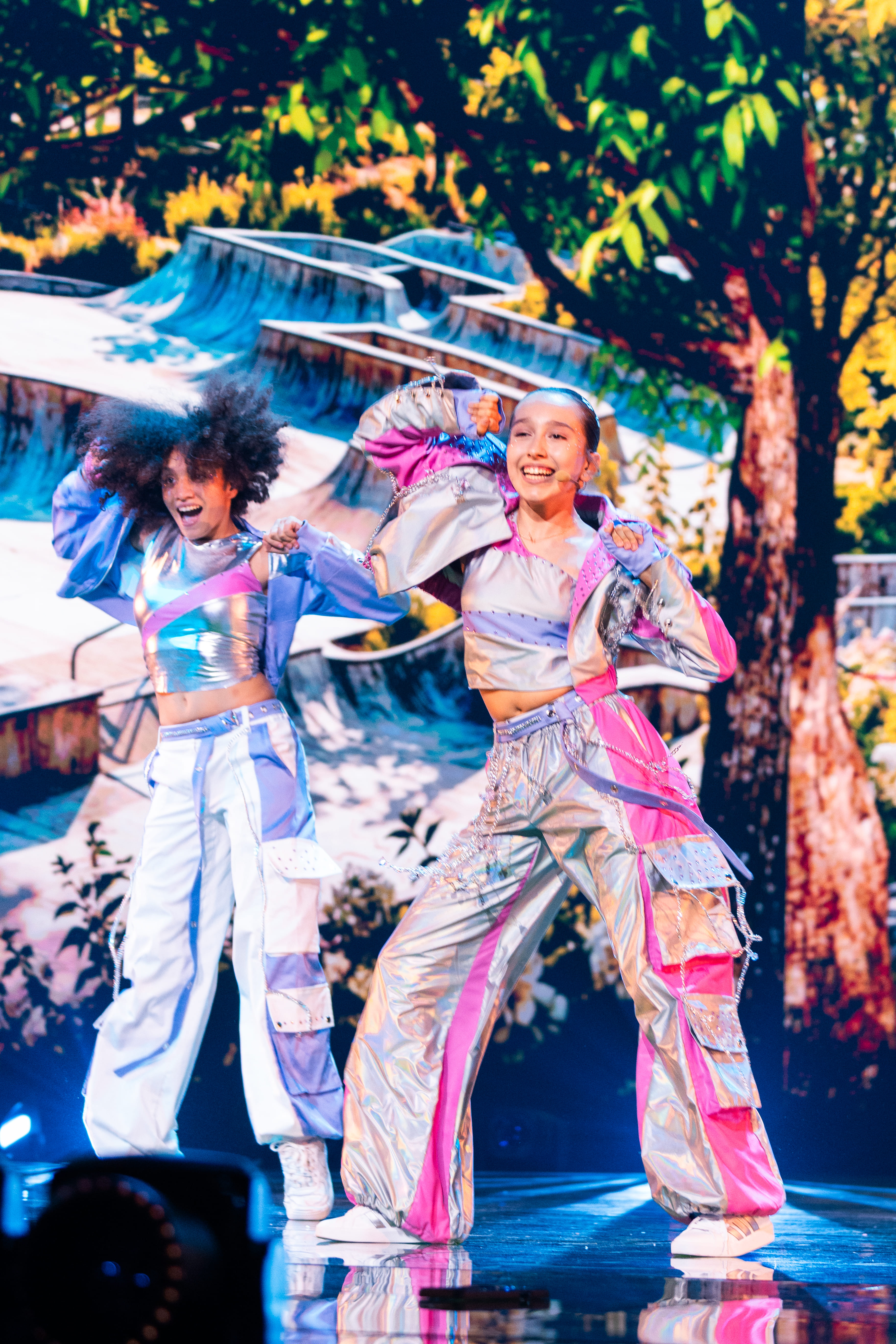
The lighting mainly uses fuchsia, magenta and electric blue tones, which alternate and contrast to create depth and movement. The strong lights outline the performers and highlight the choreography. The glossy floor also reflects both the performers and the lights, creating a symmetrical image that increases the visual impact.
The background visuals recreate a technological environment, resembling a futuristic control room, with screens, electronic panels, graphics and illuminated elements. The set creates an urban, digital atmosphere that suits the modern character of the performance.
Eslin Kurti is accompanied by dancers wearing silver and blue clothing with a sporty, futuristic style. Together, they help convey a sense of teamwork, movement and connection. Eslin stands out for her expressive gestures, smile and energetic attitude, bringing spontaneity and warmth to the performance.
It is a visually powerful performance, with eye-catching costumes, vibrant lighting and technological staging that reinforces its modern, dynamic identity.
Georgia: Davit Lomidze – «Sun on the Rooftops»
The performance by Davit Lomidze, representing Georgia at the Junior Eurovision Song Contest 2026, offers a visual presentation full of energy, colour and movement, with an aesthetic that combines traditional elements with modern, spectacular staging.
The singer wears a striking electric-blue outfit, consisting of a loose-fitting jacket, matching wide trousers and a white shirt. A green and yellow scarf tied around his neck adds an extra splash of colour, contrasting with the bright blue clothing. White trainers complete a youthful, comfortable look designed to allow freedom of movement during the performance.
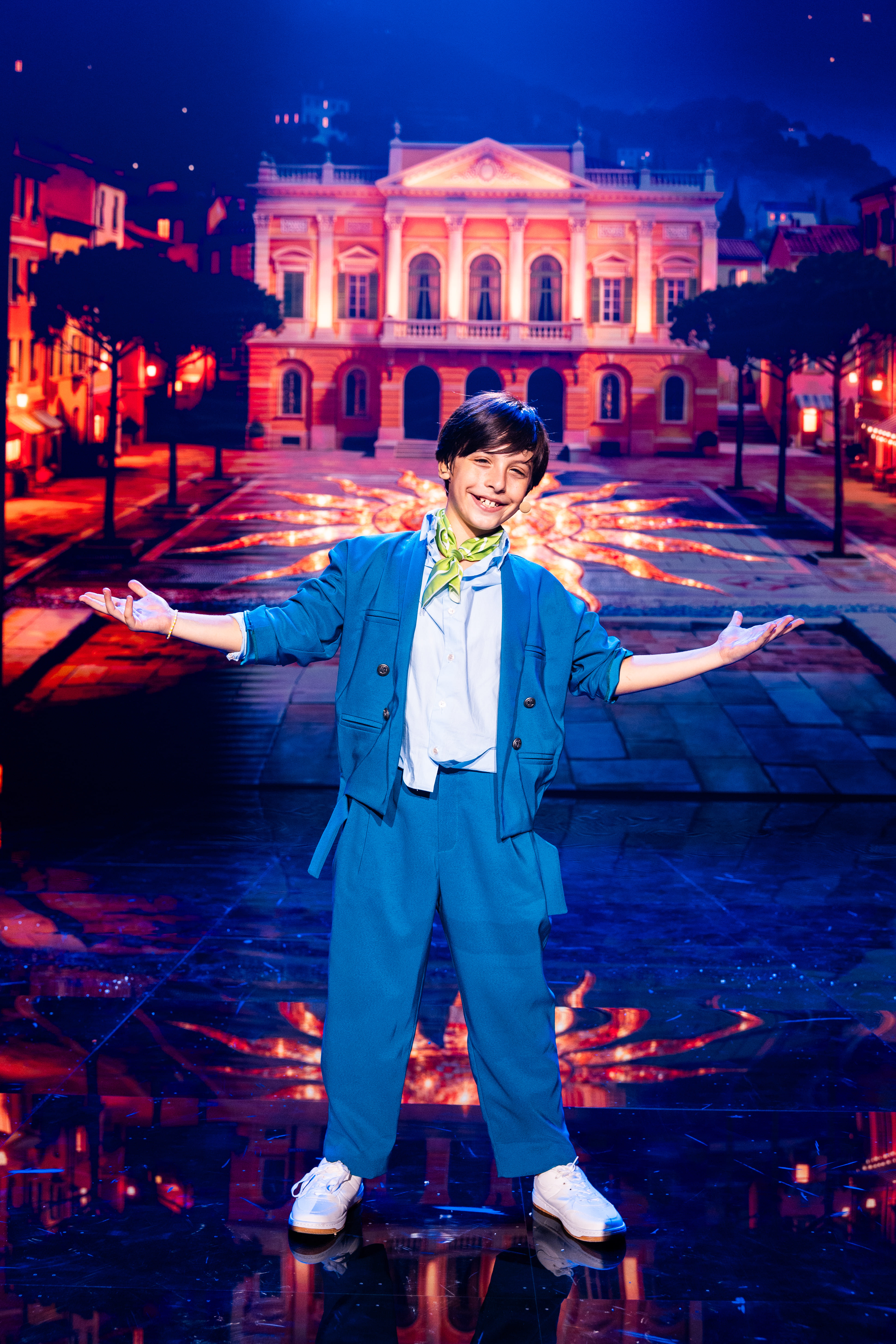
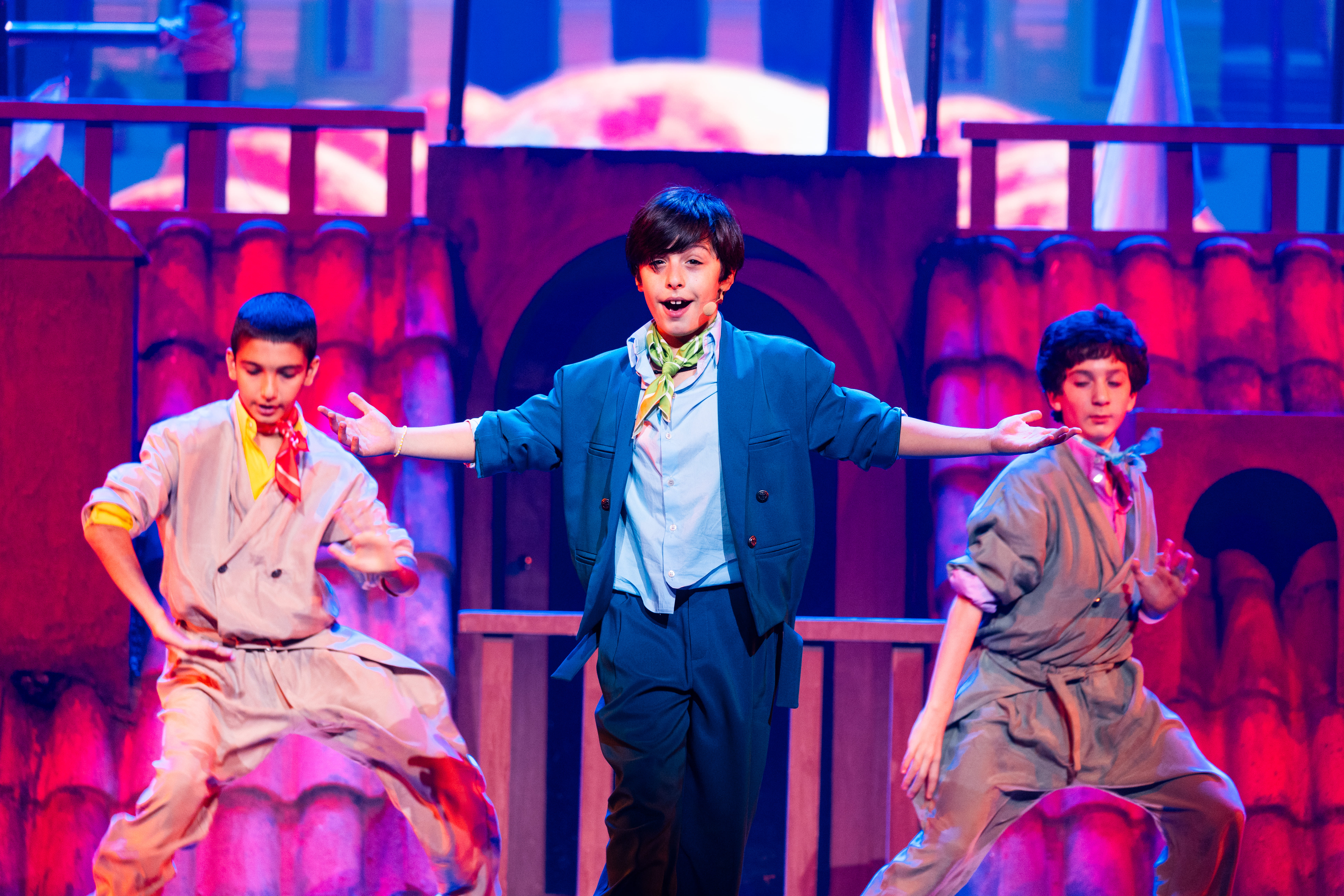
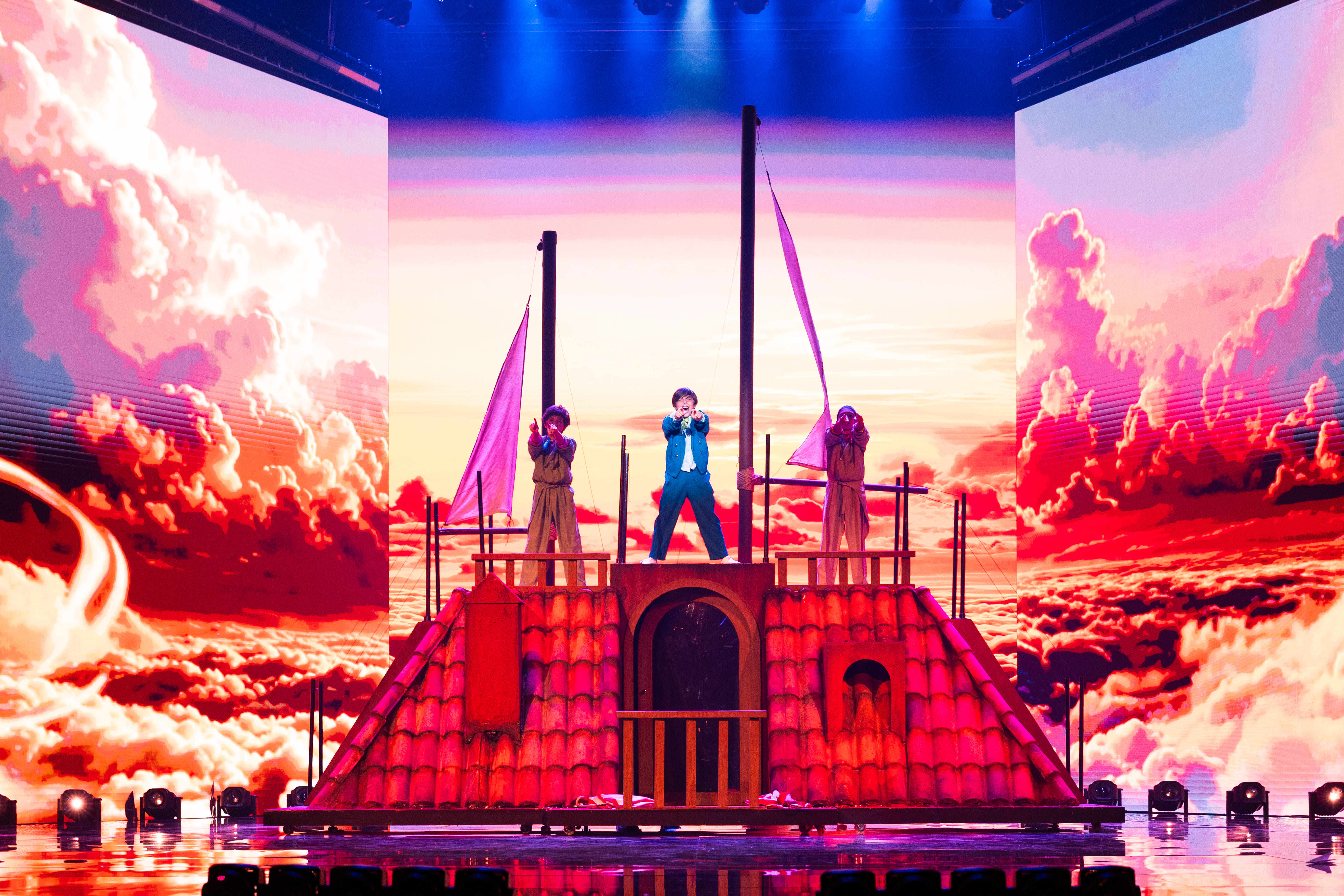
The lighting plays an important role. Blue and cyan tones dominate much of the stage, creating a vibrant atmosphere that changes with flashes of pink, red, violet and orange. Spotlights highlight the singer and create strong contrasts, while the glossy floor reflects the lights and increases the sense of depth.
The visuals show bright skies, clouds tinged with red and pink, and architectural structures reminiscent of Mediterranean rooftops and buildings. At certain moments, large umbrellas with red, white and blue stripes add movement and reinforce the theatrical character of the performance.
The singer is accompanied by two dancers wearing loose-fitting beige and grey outfits, with colourful scarves around their necks. Their movements and choreography complement the main performance, adding rhythm and visual variety. The staging also includes platforms, railings and rooftops, creating different levels and a sense of adventure.
Overall, the Georgian entry presents a youthful, dynamic and colourful performance, in which the costumes, lighting, visuals and choreography come together to create an appealing stage production full of personality.
Spain: Lucas Paulano – «Cuore Bello (Te Quiero, Te Quiero)»
The performance by Lucas Paulano, representing Spain at the Junior Eurovision Song Contest 2026, stands out for its spectacular staging, with music, costumes, projections and lighting coming together to create a magical atmosphere full of energy.
The singer wears an elegant black suit, consisting of a fitted jacket, dark trousers and a matching shirt. The outfit gives him a smart, sophisticated appearance while allowing his silhouette to stand out against the bright colours of the stage. A small detail catches the eye: a yellow decoration shaped like the province of Jaén on his lapel, contrasting with the dark clothing.
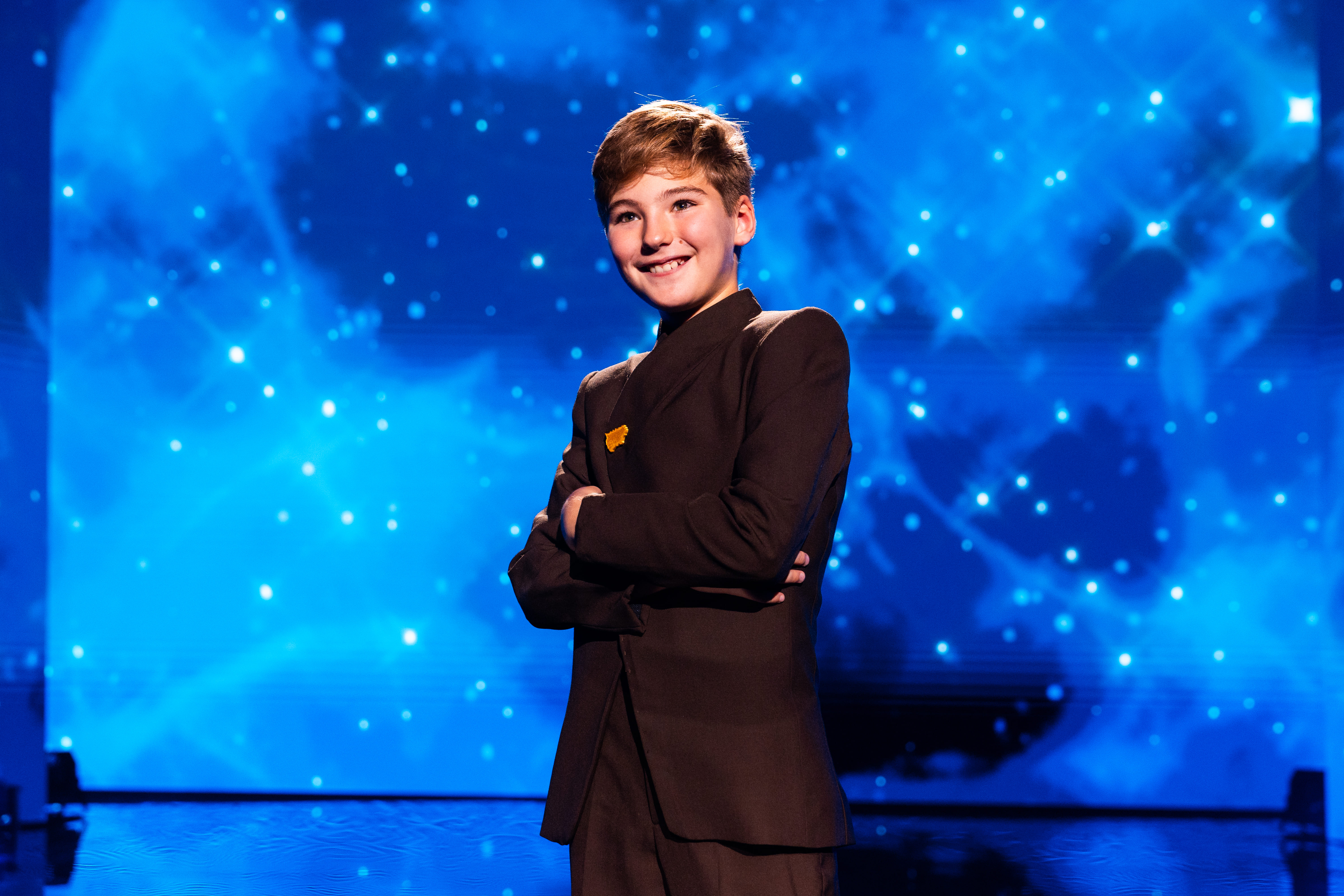
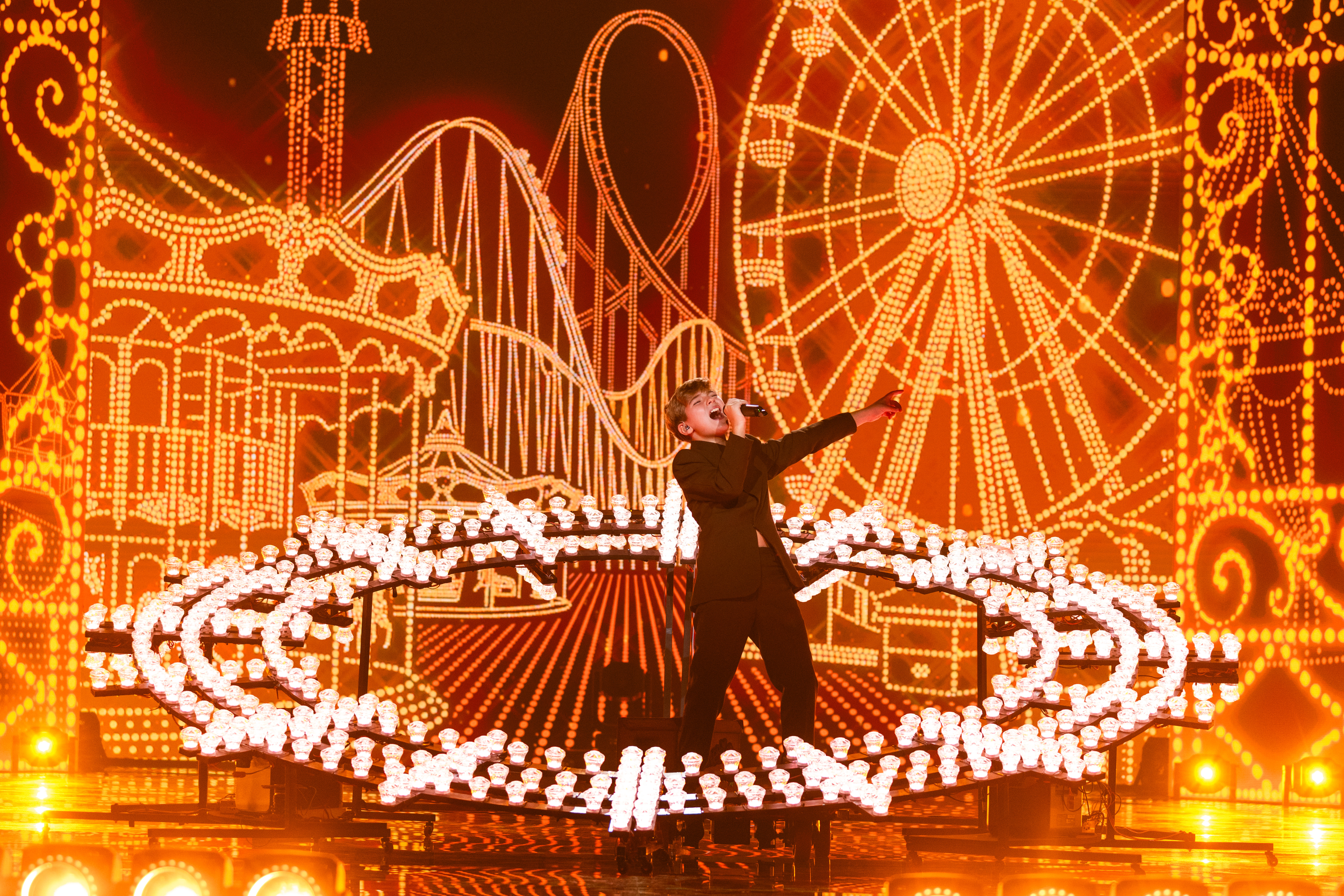
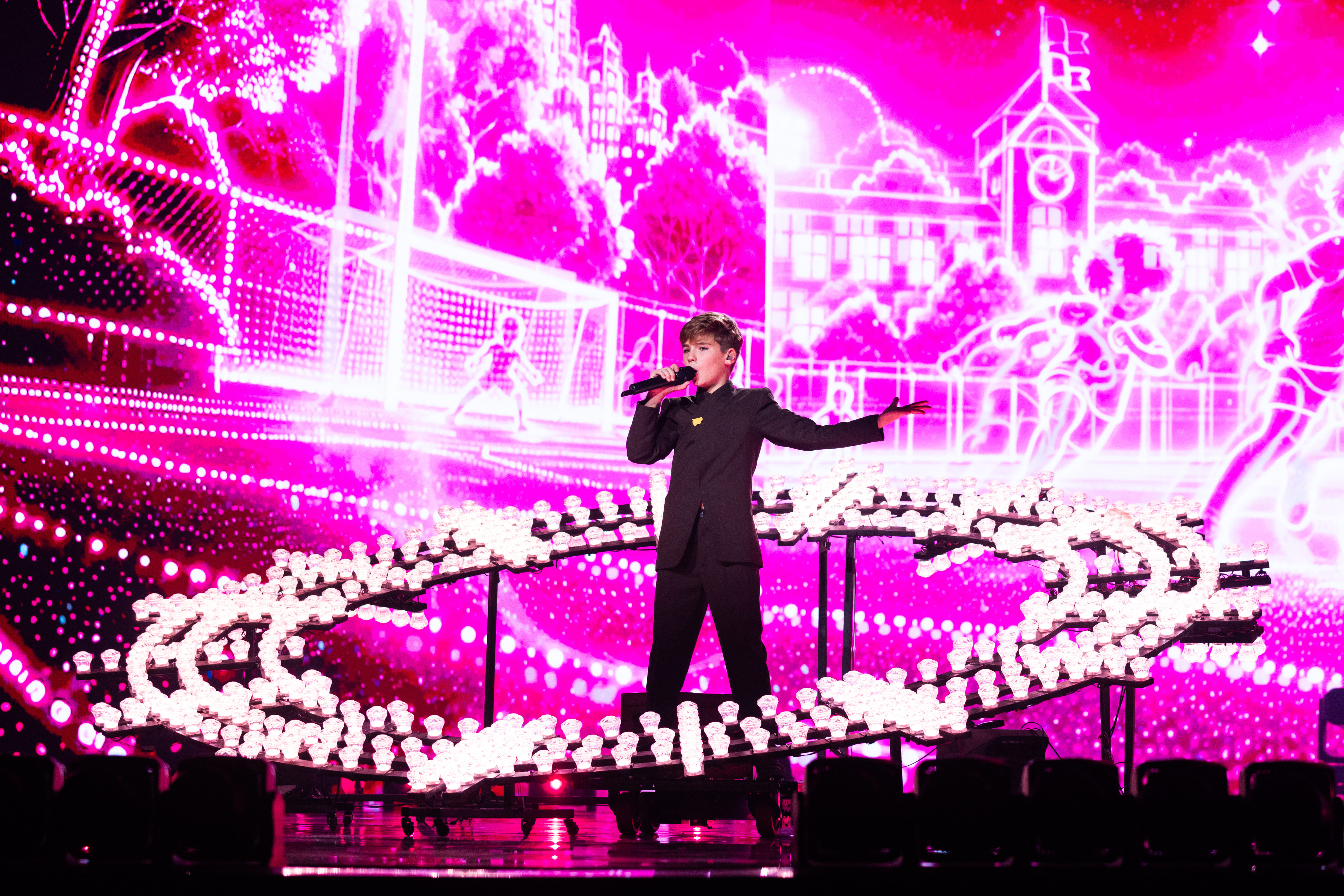
One of the most striking elements is the large circular structure surrounding the singer. It is an installation made up of several rings and curved arms, decorated with numerous small white lights that shine brightly. This creates an immersive, futuristic visual effect, as though Lucas Paulano were standing at the centre of a glowing universe. The structure also adds depth and movement to the performance, accompanying his movements and becoming an essential part of the staging.
The background visuals change throughout the performance, showing brightly coloured illustrations that evoke different imaginary worlds. One scene features a cradle, a child-like figure and elements such as stars, a moon and toys, creating a sense of tenderness. Other images show fairground rides, roller coasters and a large Ferris wheel, conveying fun and fantasy.
The lighting enhances each moment of the performance. Red, orange and golden tones create a warm, intense atmosphere, while pink and fuchsia lights bring a modern, lively feel. Overhead spotlights draw attention to the singer and highlight his presence. Overall, Lucas Paulano delivers a visually striking performance, balancing emotion, elegance and energy on stage.