

Spain has left an indelible mark on Junior Eurovision thanks to the talent of its representatives, many of whom took their first musical steps on that stage. From its debut in 2003 with Sergio García to Lucas Paulano in 2026, by way of its long-awaited return in 2019 with Melani García and the generations that followed, each artist has brought a unique voice and different emotions to the children’s contest through the messages of their songs.
Over the years, Spain has delivered memorable moments, such as second place on its debut, followed by María Isabel’s victory in 2004, and other strong results that show the artistic potential of its performers and RTVE’s enthusiasm for the children’s contest.
To look back at this history from the artists’ perspective, we review who they were, what they brought to the contest and how this children’s competition helped to shape their musical careers.
First stage: Spain’s debut and early successes at Junior Eurovision (2003–2006)
2003: Sergio
Copenhagen 2003: “Desde El Cielo”, 2nd place
Sergio Jesús García Gil, better known as Sergio, was born in Sanlúcar de Barrameda (Cádiz). At just 11, after the death of his mother, he began singing at home as a way of letting off steam. His father, a music lover, supported him, and together they started going to a small recording studio, where he sang covers of popular songs.
That interest led him to the casting for ‘Eurojunior’ in 2003, a children’s talent show run by Televisión Española to find Spain’s first representative at Junior Eurovision. Out of 3,000 candidates, he made it through every stage until he was chosen by the public in the final shows.
Sergio presented two songs for the final: “Dueños Del Amor” and “Desde El Cielo”. The latter, written with his father as a tribute to his mother, was the one chosen. With a simple but heartfelt performance, he moved audiences in 2003 and secured second place in Copenhagen with 125 points, just 9 points behind the winner.
The media impact was immediate: his performance and his story touched Spain, and his time on ‘Eurojunior’ turned him into a popular figure. In the following months, he joined the youth group 3+2 alongside other ‘Eurojunior’ contestants, with whom he recorded several albums and toured the whole country.
However, as he grew up and his personal life changed, he decided to step away from television and the media spotlight. He studied nursing in his native Sanlúcar, married and started a family, although he is still linked to music on a more personal and discreet level: today he writes songs and sings at weddings and in local musicals, while protecting his privacy.
More than 20 years after his participation, Sergio still remembers that experience fondly. For many, his “Desde El Cielo” not only marked a turning point in Spain’s history at Junior Eurovision, but also helped the contest become a serious platform for discovering young talent.
2004: María Isabel
Lillehammer 2004: “Antes Muerta Que Sencilla”, 1st place
María Isabel López was born in Ayamonte, in the province of Huelva. From a very young age, she showed artistic leanings towards singing and dancing; she also studied piano, but she soon opted for singing and performing, feeling at home in the spotlight.
At 9, she took part in the national casting organised by TVE for ‘Eurojunior’. After competing with thousands of children from all over Spain, María Isabel was chosen as the country’s representative at the European children’s contest. Her song, “Antes Muerta Que Sencilla”, written by her with José Muñiz, won the contest with 171 points and eight sets of 12 points, a sign of overwhelming support. In Spain, the broadcast drew an audience of 5,912,000 viewers, with a share of around 39.1%.
After her victory, her career exploded: she released her first album, went on tour and made numerous television appearances, becoming one of the most recognisable young faces on the music scene.
Between 2011 and 2015, she took a break from her career, mainly to focus on her studies, before returning to music with a new album, Yo Decido. With its first single, “La Vida Solo Es Una”, she entered Objetivo Eurovisión 2016, finishing fourth; the selection was won by Barei with “Say Yay!”. She later released singles such as “Flamenkita”, “Tu Mirada” and “Esa Carita”, the latter with Juan Magán, and took part in ‘Tu Cara Me Suena 8’.
In summer 2021, she announced her retirement from music for mental health reasons and stayed away from the industry for some time. In 2022 she announced her pregnancy on social media, and her daughter Daliana was born in 2023. In 2024, she returned to television in Telecinco’s ‘Bailando con las estrellas’; in October of that year, she announced her return to music for January 2025, and in November she made an appearance at the Junior Eurovision Song Contest 2024 in Madrid.
2005: Antonio José
Hasselt 2005: “Te Traigo Flores”, 2nd place
Antonio José Sánchez Mazuecos was born in Palma del Río, in the province of Córdoba, and showed an interest in music from an early age. Aged just 10, in 2005, he was chosen to represent Spain at Junior Eurovision with “Te Traigo Flores”, which he performed at the contest held in Hasselt, Belgium. In a very close vote, he finished second with 146 points, just three points behind the winner.
After the contest, Antonio José released his first album, named after his Eurovision song: Te Traigo Flores. In 2015, he took part in the third edition of ‘La Voz’, which he went on to win. That victory reopened the doors of the music industry for him. From then on, his career gathered pace and he released several albums, establishing himself as one of the young artists with the strongest presence on the Spanish pop-flamenco scene.
Over the years, Antonio José has matured as an artist, with albums exploring new sounds, deeper lyrics and a more defined identity. El Viaje came out after his triumph on ‘La Voz’.
It was followed by Senti2 in 2016 and A un Milímetro de Ti in 2017, which became one of the most decisive albums of his career. He later released Antídoto and Fénix, consolidating his career as one of the stars of Spanish pop.
His most recent album, El Pacto, was released in 2023, and since then the artist has embarked on a long series of concerts across Spain and abroad.
2006: Dani Fernández
Bucharest 2006: “Te Doy Mi Voz”, 4th place
Dani Fernández closed Spain’s first stage at Junior Eurovision as one of the most charismatic representatives of his generation and one with the greatest artistic potential. At just 14, he took to the European stage to perform “Te Doy Mi Voz”, finishing fourth with 90 points.
A few years after Junior Eurovision, his career took a decisive turn when he joined the boy band Auryn, one of the biggest musical phenomena in Spain in the 2010s. With them he released several albums, earned gold and platinum records, played packed tours and enjoyed unprecedented success. The band came close to representing Spain at the Eurovision Song Contest 2011, finishing second in the national selection.
After the group split up, Dani Fernández embarked on a solo career that has become one of the most important chapters of his professional life. His first album, Incendios, marked a turning point, revealing a more personal, more acoustic side with an adult pop-rock style.
He then released Incendios y Cenizas, an expanded reissue that strengthened his presence in the industry. His consolidation came with Entre las Dudas y el Azar, released in 2022: a deeply reflective and emotional album that earned certifications, produced some of the most-played hits in his repertoire and brought him several awards.
His latest album, La Jauría, shows a clear musical maturity, with honest lyrics and a contemporary sound that has made him a leading figure in today’s Spanish pop, backed by a long international tour.
Spain at Junior Eurovision between 2007 and 2018: a 13-year absence
After the initial period of success between 2003 and 2006, Spain withdrew from Junior Eurovision in 2007. The decision was announced by RTVE, which argued that the contest “promotes stereotypes that we do not share”. Over the following 13 years, Spain stayed away, despite the cultural and media legacy left by its first participations.
Finally, in June 2019, RTVE confirmed its return to the contest, ending that long hiatus and marking a new beginning in its Junior Eurovision history.
The long-awaited return: a new era for Spain at Junior Eurovision
In 2019, RTVE officially confirmed Spain’s return to the contest after 13 years of absence. The comeback was a firm commitment to restoring Spain’s presence at the children’s contest, with a new focus on more carefully crafted productions and a responsible internal selection.
Since its return, Spain has strung together several editions with very encouraging results. In 2019, it came back with Melani García and “Marte”, achieving a commendable third place. The following year, in 2020, Soleá represented the country with “Palante”, staying on the podium with another third place. In 2021, however, with Levi Díaz and “Reír”, Spain dropped to 15th place.
2019: Melani García
Gliwice-Silesia 2019: “Marte”, 3rd place
Melani García was the first Spanish representative after RTVE’s return in 2019, following 13 years of absence. Having recently turned 12, she was internally selected by the public broadcaster and her selection was revealed in a live announcement, fulfilling a dream she had spoken about since she was a little girl.
Her song, “Marte”, carried a message about protecting the oceans and fighting pollution, which gave Spain’s comeback a serious and educational touch. Her operatic voice and her stage presence moved both the juries and the public, taking her to third place with 212 points, a result that brought back enthusiasm among fans of the contest.
Since Junior Eurovision, she has released several singles, such as “Valientes”, “Adiós” and “Grita Conmigo”, showing her desire to grow as an artist and explore more contemporary sounds, far from the operatic style that made her known.
In 2022, she released the single “Huellas”, featuring Ruth Lorenzo. 2024 was a big year for Melani García. On 29 March, she was one of the hosts of PrePartyES in Madrid, alongside Víctor Escudero and María Isabel, and took the opportunity to present her single “Mi Voz”.
At the end of the year, Melani García made her debut as a host of Junior Eurovision 2024, fulfilling one of her dreams. She was joined by Eurovision star Ruth Lorenzo and well-known actor Marc Clotet on the impressive stage set up at the Caja Mágica in Madrid, at a musical event held on 16 November with great success. After this milestone, she took part in ‘Tu Cara Me Suena 12’, which she went on to win.
2020: Soleá
Warsaw 2020: “Palante”, 3rd place
The choice of Soleá Fernández Moreno in 2020 was a clear bet on traditional musical roots. Aged just 9 and coming from a family well known in the world of flamenco, a descendant of the Farruco dynasty, she performed “Palante”. It was an urban pop song with contemporary influences that, according to RTVE itself, aimed to convey a message of hope and optimism at a time marked by the pandemic. The entry gave Spain another third place, this time with 133 points.
Although she took part in the contest at a very young age, and her participation was marked by the COVID-19 pandemic, which meant she could not travel to another country for the contest, she already had plenty of experience: from a very early age, she had taken part in family shows, worked on theatre tours and shown her talent on regional television.
After a short break following the contest, she returned in 2021 with two singles, “Báilalo” and “Con Arte”. In 2022, she came back with new songs such as “Dicen” and “Pose, Pose”. After that, she released a version of “And I Am Telling You I’m Not Going” in 2023 and “Se Pasa” in 2024.
2021: Levi Díaz
Paris 2021: “Reír”, 15th place
Levi Díaz was chosen in September 2021 as Spain’s representative for that year’s contest in Paris, the third consecutive internal selection since Spain’s return. Before that, Levi had won the sixth edition of ‘La Voz Kids’, so he arrived at the contest with experience, clear ambitions and a profile suited to modern pop music.
His song, “Reír”, came at a special time, as the 2021 edition marked the return of in-person events after the pandemic restrictions, and Levi performed it with the excitement of representing a new generation of young Spanish talent. Although it was a demanding edition, his participation symbolised Spain’s continuity at the contest. In Paris, he scored a total of 77 points, finishing 15th out of 19 participants, which was, at the time, Spain’s worst result at the contest.
After a short break following the contest and several performances, Levi Díaz’s last public appearance was in 2022, at Madrid’s LGBTIQ+ Pride celebrations. There, he gave an emotional closing speech, calling for more visibility, safety and representation for the community, after speaking publicly about his sexual orientation.
In 2022, RTVE began a major push for Junior Eurovision, opening the selection process to the country’s young talent through public calls, although the final choice remained internal. This new stage brought a revival with Carlos Higes and “Señorita”, which finished sixth.
Since then, Spain has achieved second place with Sandra Valero and “Loviu” in 2023, when she shared the final screen with the French winner; another sixth place with Chloe DelaRosa and “Como La Lola” in 2024; and a brilliant fifth place with Gonzalo Pinillos and “Érase Una Vez (Once Upon a Time)” in 2025. In 2026, Lucas Paulano takes over with “Cuore Bello (Te Quiero, Te Quiero)”.
2022: Carlos Higes
Yerevan 2022: “Señorita”, 6th place
Carlos Higes was internally selected after an open call. His song, “Señorita”, was presented as a modern, dynamic entry with Latin rhythms, aiming to win over European audiences with a catchy style. From the very beginning, his spontaneous personality and confidence made him one of the representatives most loved by young viewers. His entry was rewarded with 6th place and 137 points, which once again put Spain in a prominent position and showed that the country was maintaining a high competitive level in its new stage at the contest.
Since the contest, Carlos has continued to develop his musical career and media presence. He has taken part in television galas, concerts, recordings and various entertainment programmes. He was also Spain’s spokesperson, announcing the Spanish jury’s votes at the 2024 edition, reaffirming the special bond he maintains with the Eurovision world.
Artistically, he has continued training in singing and stage performance, broadening his vocal range and exploring pop and urban sounds.
Since the contest, he has released several songs, including “Mi Mundo”, “No Me Digas Que No” and “Bajo El Sol”.
2023: Sandra Valero
Nice 2023: “Loviu”, 2nd place
In 2023, Sandra Valero became one of the most brilliant and charismatic Spanish representatives of recent years. Her entry, “Loviu”, combined charm, freshness and an international image that quickly connected with fans of the contest.
From her official presentation, the young singer from Valencia captivated audiences with her strong voice, her sweetness and an innate expressiveness, qualities that placed her among the favourites of the edition from the start. Her performance stood out for its vocal precision, charisma and emotional connection with the audience, who followed it enthusiastically both in the arena and on screen. The final result was a spectacular second place with 201 points, putting Spain back on the podium.
After this international success, Sandra continued to develop her artistic career. She took part in special programmes and Christmas performances, as well as television projects that broadened her public profile. In 2024, she released the single “Como Maléfica”, a song with a stronger aesthetic personality and a punchy pop sound, showing her ambition to keep growing beyond the Eurovision world.
After the devastating DANA that hit the Valencian Community, causing serious damage, deaths, flooding and a huge social impact, Sandra Valero released a song in 2025 called “Som València” as a tribute and a gesture of solidarity with her homeland. The video description explains that the song was born “in the midst of that context”, as a symbol of memory, unity and resilience for the people of Valencia.
The song aims to pay tribute to the victims, the families affected and all the residents who suffered the consequences of the storm. In addition, the rights generated by this single will be donated to the non-profit organisation Ecometta, to help with reconstruction and support those affected.
2024: Chloe DelaRosa
Madrid 2024: “Como La Lola”, 6th place
Chloe DelaRosa’s participation in 2024 was one of the most special in Spain’s history at the contest, as the edition was held in Madrid, making the young performer the home artist at a historic show. Aged just 9, Chloe presented herself as an artist full of energy, freshness and naturalness, impressive in front of the cameras.
Her song, “Como La Lola”, offered a fusion of pop with flamenco touches, conveying a very distinctive identity representative of Spanish character, something that set it apart from the rest of the European entries. Spain finished 6th with 144 points.
Since the contest, Chloe has started to build her musical career. She has continued training in singing and dance, and her popularity has allowed her to build an active presence on social media, where she connects with thousands of followers.
In just one year, she has released songs such as “Verano, qué verano”, “Patinete” and “La fiesta de mi recreo”, three releases that reflect different sides of her artistic identity. With “Patinete”, released in 2025, Chloe leans towards a more urban style, combining rhythms close to dembow with lyrics focused on self-confidence and freedom. Meanwhile, “La fiesta de mi recreo”, her most recent release, continues along that musical line, blending pop and urban elements.
2025: Gonzalo Pinillos
Tbilisi 2025: “Érase Una Vez (Once Upon a Time)”, 5th place
With Gonzalo Pinillos, Spain approached Junior Eurovision 2025 with high expectations after serving as host country in 2024. RTVE internally selected the 14-year-old artist from Madrid, who had experience in musical theatre, to fly the Spanish flag at the 23rd edition of the contest, held in Tbilisi (Georgia).
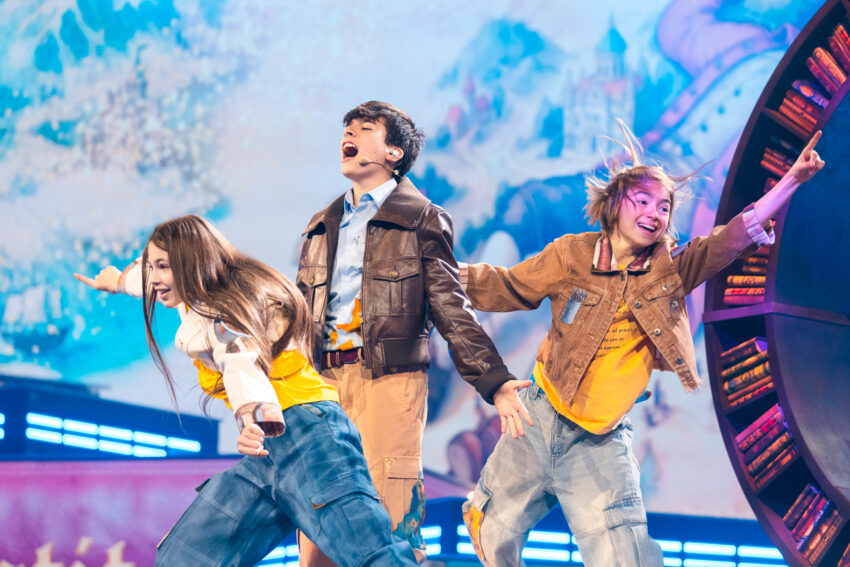
The Spanish representative performed “Érase Una Vez (Once Upon a Time)”, a pop song with theatrical influences sung in Spanish, English and French. The song carried a universal message about the power of imagination and reading, encouraging young people to dream through books. The entry combined creativity and optimism, consolidating Spain’s track record at the contest and reaffirming its commitment to the talent of new generations.
On stage, Gonzalo Pinillos delivered a visually polished performance, accompanied by Álex Garrido and Daniela Valladolid, in which his vocals, choreography and piano stood out, in a staging inspired by literary fantasy.
In the end, Spain achieved a commendable 5th place with 152 points (98 from the professional juries and 54 from the online vote), securing a new Top 5 for the Spanish delegation and maintaining the country’s strong run at the children’s contest. After his great performance, Gonzalo Pinillos said he was grateful for the experience and for the support he had received.
Since Junior Eurovision 2025, Gonzalo Pinillos has continued to build his artistic career, especially in musical theatre and music. The young artist has remained on stage while combining his musical and academic studies.
His time at Junior Eurovision also gave him greater media exposure and has allowed him to keep performing on major national stages. Among the highlights was his first solo concert at Sala Clamores in Madrid, on 23 May, where the young artist performed songs such as “So Easy (Fall in Love)” in an intimate and personal setting and, of course, his Eurovision hit “Érase Una Vez (Once Upon a Time)”.
2026: Lucas Paulano
Ta’ Qali 2026: “Cuore Bello (Te Quiero, Te Quiero)”
Lucas Paulano is Spain’s representative at the Junior Eurovision Song Contest 2026. The 10-year-old singer from Jaén rose to fame in 2025, when he won the 10th edition of ‘La Voz Kids’ and became, at just 8, the youngest winner of the show in Spain. RTVE selected him internally and announced him on 30 July 2026 on the programme ‘El perro andaluz’.
His entry, “Cuore Bello (Te Quiero, Te Quiero)”, was written by Dangelo; Blas Cantó, Spain’s representative at the Eurovision Song Contest 2021; and Carlos Almazán, with the participation of Lucas Paulano himself. The song, which links love and memory, was released together with its official music video on Monday 28 September. The staging is by Javier Pageo, who had already designed the performances of Sandra Valero and Chloe DelaRosa.
It will be Spain’s 12th participation at the contest. Lucas Paulano will close the show, performing 16th and last, on Saturday 24 October at the Malta Fairs & Conventions Centre (MFCC) in Ta’ Qali (Malta), where he will try to extend Spain’s strong run since its return in 2019.