

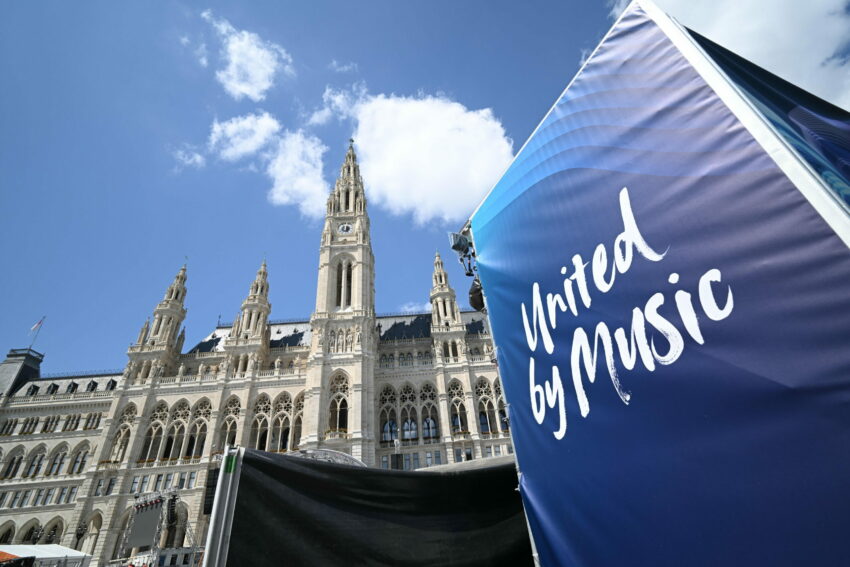
This Sunday, May 10 marks the official start of Eurovision Song Contest 2026 week. After several days of rehearsals, the city of Vienna hosts the opening of the 70th edition in a climate of tension caused by Israel’s participation, which has led to an unprecedented boycott of the contest with the withdrawal of five countries (Slovenia, Spain, Ireland, Iceland, and the Netherlands).
For the third consecutive edition, the geopolitical context is fully entering the musical competition, further shifting the atmosphere of uncertainty in which the event takes place, an event that should be the great European musical celebration, but is not unfolding as such.
On one hand, Vienna’s Rathausplatz is being decorated to promote the contest with the parade of the 35 participating delegations. On the other, the Austrian capital is preparing for planned protests related to Israel’s participation. Groups of pro-Palestinian activists have organized parallel events and demonstrations calling for the expulsion of the Israeli broadcaster from the contest due to the genocide in Gaza and the country’s military actions in the Middle East conflict.
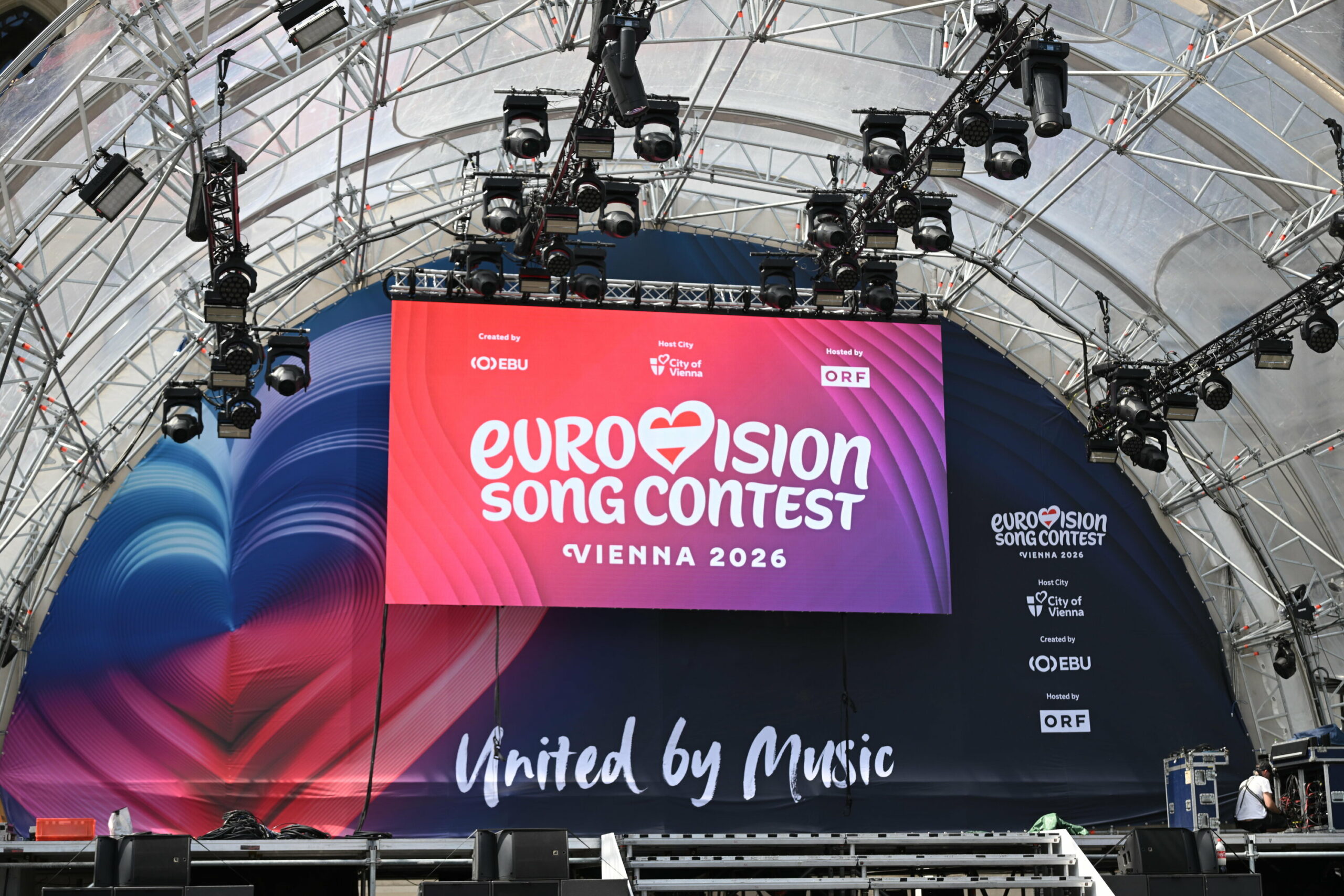
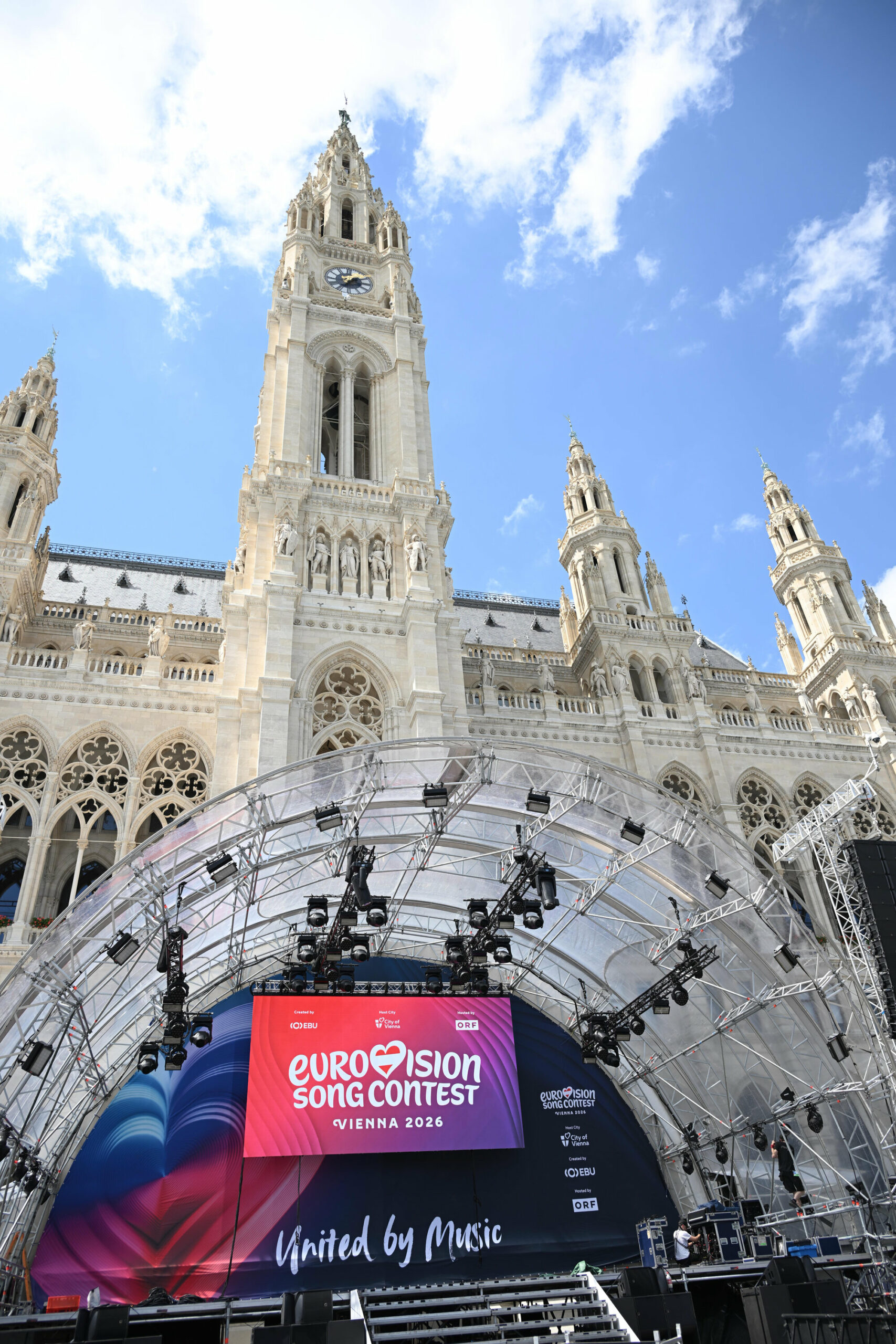
Far from being the grand showcase of the 70th anniversary of the Eurovision Song Contest, Israel’s participation once again clouds the turquoise carpet and the opening ceremony, which were meant to be celebrations of the contest’s European values such as peace, diversity, and unity through music.
As usual, the parade of delegations will be broadcast live. Meanwhile, the opening ceremony will include a subsequent inauguration party for the delegations. In this latter case, it will not be public nor will it be broadcast.
Admission will be free depending on the venue’s capacity and the security measures implemented by the authorities of the Austrian capital. In fact, the city of Vienna is currently heavily secured (“on lockdown”) due to the presence of the 35 delegations and thousands of visitors.
When and how to watch the Eurovision 2026 Turquoise Carpet?
The turquoise carpet and the opening ceremony mark the beginning of an intense week in Vienna (Austria), which will feature activities for visitors at the Eurovision Village, as well as musical gatherings at the EuroClub and live shows. In addition to this, there will be parallel events and demonstrations protesting Israel’s participation and in support of Palestine.
Remember that you will be able to follow the Eurovision Song Contest 2026 Turquoise Carpet live this Sunday, May 10, starting at 16:55 CEST from the channel.
What will be the order of welcome for the participants of Eurovision 2026? Review the details of Vienna’s Turquoise Carpet
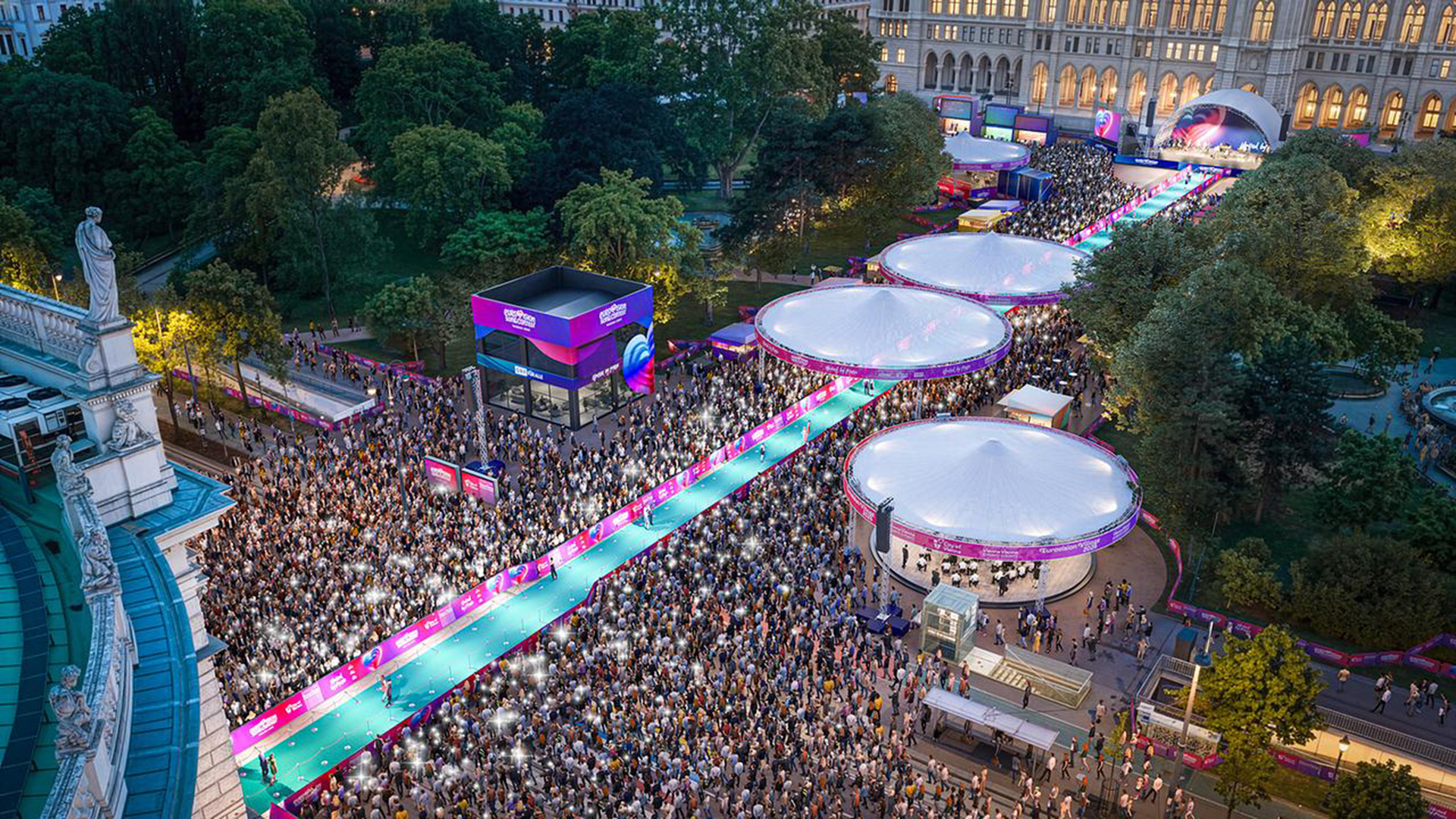
This official kickoff is scheduled for this Sunday, May 10, starting at 17:00 CEST, at City Hall Square in Vienna (Wiener Rathausplatz). The venue, one of the most prominent tourist landmarks in the Austrian capital, hosts this opening event with the parade of the competing delegations in alphabetical order.
On this occasion, the 35 participants in this year’s Eurovision Song Contest will walk the traditional turquoise carpet in three-minute intervals. Below are the participating countries that will parade along the Vienna 2026 turquoise carpet:
The artists will walk along the turquoise carpet that will stretch across the entire Wiener Rathausplatz. The straight route will connect Vienna City Hall (Wiener Rathaus) and the Universitätsring.
The 35 artists will depart from the Burgtheater. All of them will stop along the route so accredited media can photograph them. They will also be interviewed for the official broadcast for an estimated duration of one minute. The route will conclude with a grand reception on the main stage in front of the audience. At 18:50 CEST, JJ, winner of the Eurovision Song Contest 2025, and the Vienna Radio Symphony Orchestra (RSO) will close the event with “Wasted Love.”
The event will begin with the Eurovision title sequence, whose anthem will be performed by the Vienna Radio Symphony Orchestra (RSO). Additionally, the turquoise carpet will feature a short musical welcome by the Woodstock Allstar Band, which will perform a well-known song from each country.
Why is the Eurovision carpet turquoise and not red?
Since the Eurovision Song Contest 2018 held in Lisbon (Portugal), the carpet stopped being red and changed its color to a different one in order to give a distinctive and personal touch to each edition. That year it was blue, referencing the water and oceanic character that defined the slogan and visual identity of that edition.
However, since 2019, the color of the carpet has been determined by the official sponsor of the Eurovision Song Contest, which is once again the haircare brand Moroccanoil. Therefore, for the sixth consecutive year, the carpet will be turquoise, as in Rotterdam 2021, Turin 2022, Liverpool 2023, Malmö 2024, and Basel 2025.
The presence of Moroccanoil as a sponsor continues to be a source of controversy, as many critical voices argue that the Israel-based beauty products brand could be one of the reasons why Israel has not been expelled from the European contest.
Protests and demonstrations in Vienna over Israel’s participation in Eurovision 2026
What used to always be the best week of the year will, this year, be overshadowed by the boycott of the Eurovision Song Contest, the absence of important countries, and an atmosphere of tension and discontent never before seen in the contest. All of this comes despite Vienna’s attempts to deliver a high-level opening event.
The Austrian capital had hoped to vibrate to the rhythm of Eurovision music, but what resonates most across Europe are the voices and demonstrations against Israel’s participation. In fact, in Vienna, major associations and groups have prepared a series of gatherings throughout the week to raise their voices against the genocide in Gaza and to criticize Israel’s presence in the contest, which they describe as an unacceptable act of international “whitewashing.”
The reality is that protests against Israel’s participation have become a constant in recent editions of the European contest, from the demonstrations outside the Malmö Arena in 2024 to the gatherings during the opening of Basel 2025, and even inside the St. Jakobshalle during a dress rehearsal that forced security teams to intervene.
According to Austrian law, protests must be registered at least 48 hours in advance. At the moment, according to Reuters, the police have no record of prior mass gatherings for the opening day of Eurovision week. However, the police are expecting blockades, acts of vandalism, and unauthorized spontaneous protests.
So far, some demonstrations have been registered for next week against Israel’s participation, with an estimated attendance of up to 3,000 people.
“We expect that, indeed, there will be blockades and acts of vandalism, especially on the day of the final, whether through authorized or unauthorized gatherings.”
Xenia Zauner, senior police official of Vienna
Local authorities estimate that the day of highest tension will be Friday, May 15, on the occasion of the commemoration of Nakba Day, a date on which Palestinians remember the loss of their land after the 1948 war following which the State of Israel was established.
Being a day with “great emotional significance for the pro-Palestinian movement,” in the words of Xenia Zauner, senior police official of Vienna, the police are preparing to face a wide range of threats.
Among the measures imposed is the ban on the use of drones within a 1.5-kilometer radius of key Eurovision 2026 venues (Wiener Stadthalle, Eurovision Village, EuroCafe). In addition, they are working in cooperation with a task force at the United States Federal Bureau of Investigation (FBI), with which Austrian authorities will be able to make contact 24 hours a day to address cyber threats.
Currently, Austria’s terror alert level remains at the second-highest level, as it has for the past two years. Security forces emphasize that there is no specific threat against the Eurovision Song Contest, according to Dieter Csefan, vice president of the Vienna police.
According to the police, those attending the event should expect airport-like security checks, and will only be allowed to bring small, transparent bags inside. These security measures will also be implemented in the live broadcast viewing area at the Eurovision Village in front of Vienna City Hall.