

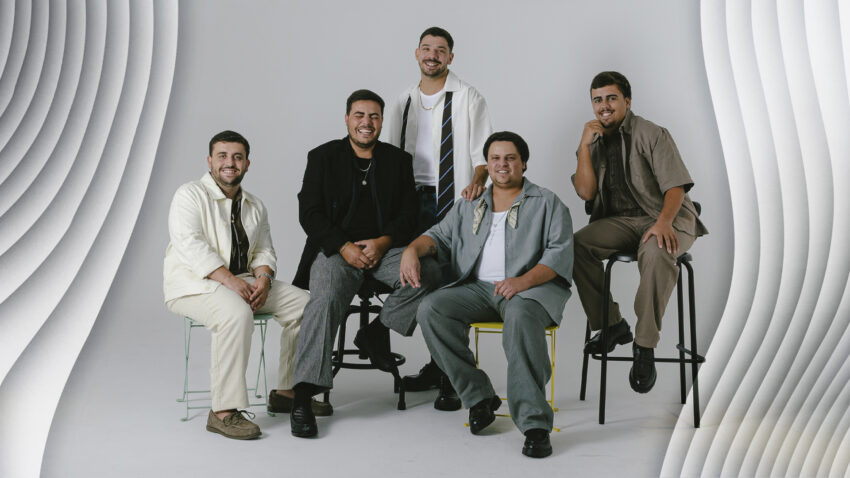
The Eurovision Song Contest is heading towards its 70th edition, which will take place in Vienna (Austria) on May 12, 14, and 16 at the Wiener Stadthalle.
Following the decision of the Portuguese public broadcaster RTP to compete in the Eurovision Song Contest 2026 despite Israel’s participation, there were many critical voices calling for a boycott. Among them were most of the composers and artists who took part in the Festival da Canção 2026.
Finally, the winners of the competition, the group Bandidos do Cante with “Rosa”, were one of only two participants who had publicly expressed their willingness to accept the invitation from RTP to go to Vienna.
How did they reach Eurovision? How did the creation of the musical group come about? How are they preparing their entry for Vienna 2026?
On this occasion, we review the musical career of Bandidos do Cante, the context of their candidacy, and their song. The Portuguese representatives at the Eurovision Song Contest 2026 aim to take their country to the Grand Final with “Rosa”, in what will be Portugal’s 57th participation in the European contest.
This is Bandidos do Cante, the Alentejo soul
Bandidos do Cante is a Portuguese group formed by Miguel Costa, Duarte Farias, Francisco Raposo, Luís Aleixo and Francisco Pestana, mostly originating from the Alentejo region. Their musical proposal is based on cante alentejano, a choral tradition recognised as Intangible Cultural Heritage of Humanity, which they reinterpret with a contemporary approach incorporating pop elements. This fusion has allowed them to bring a genre deeply rooted in Portuguese culture closer to new generations.
Cante alentejano, characterised by its a cappella performance and choral structure led by solo voices, is one of the group’s main defining features. Raised in this musical environment, the members grew up listening to and taking part in these traditions, which led to their artistic connection from a young age. The project emerged spontaneously after a gathering among friends in which they began singing together, leading them to record a version of the song «CASA», which became very popular in Portugal.
In their early days they were known as Amigos do Alentejo, but adopted the name Bandidos do Cante in 2023. That same period marked the beginning of their consolidation, participating in musical projects alongside the group D.A.M.A. In 2024 they achieved their first major success with «Amigos Coloridos», a song that defined their style and was very well received, leading them to carry out an extensive tour across the country.
The following year they released «Já Não Há Pardais No Céu», strengthening their musical identity and gaining recognition in the industry, including a nomination as breakthrough artist. Their growing popularity was reflected in notable performances and concerts with large audiences.
In 2026 they released their debut album, Bairro das Flores, a work that combines tradition and modernity, featuring collaborations with well-known artists.
This is “Rosa”, the proposal by Bandidos do Cante to represent Portugal at Eurovision 2026
The quintet Bandidos do Cante represent Portugal at the Eurovision Song Contest 2026 with their song “Rosa”, composed by the five members of the vocal group together with Francisco Pereira, Gonçalo Narciso, Gui Alface, José Carlos Coelho, and Almeida Tavares.
The song “Rosa” features a nostalgic lyric that speaks about a past love that remains strongly present in memory. It uses the garden and roses as a metaphor for the relationship, surrounding the listener with a calm and melancholic atmosphere.
The wind, the night, and the scent of roses convey the feeling of thinking about someone who is no longer there, as if love had been stored in those small details. The “garden” becomes “saudade”, that uniquely Portuguese mix of nostalgia and affection. All of this, together with regret, memories, and true love, forms the fundamental pillars of the entry.
Lyrics
Portuguese
No silêncio do luar
Sopra o vento devagar
Traz o cheiro das roseiras
E o teu nome a sussurrar
Meu amor se hoje for
À noitinha ao meu jardim
Por lá encontrarei rosas
Fazem-me lembrar de ti
Não há pressa de onde eu sou
Não há preço p’ra esta calma
Se falhei paguei em dobro
Sobrou pouco ou quase nada
Só as rosas que plantei
Quando a gente era verdade
Sobrou pouco, eu não reguei
E o jardim virou saudade
Meu amor se hoje for
À noitinha ao meu jardim
Por lá encontrarei rosas
Fazem-me lembrar de ti
Fazem-me lembrar de ti
Com saudade do teu beijo
És a rosa mais bonita
Que brotou ao sul do Tejo
Fazem-me lembrar de ti
Com saudade do teu beijo
És a rosa mais bonita
Que brotou ao sul do Tejo
És a rosa mais bonita
Que brotou no Alentejo
English
In the silence of the moonlight
The wind blows slowly
It brings the scent of rosebushes
And it whispers your name
My love, if this evening
I set foot in my garden
There I will find roses
They remind me of you
There is no rush in the place I come from
There is no price for this peace
If I failed, I paid in double
Little remains, or almost nothing
Only the roses I have planted
When we were true
Little remains, I didn’t water them
And the garden turned into longing
My love, if this evening
I set foot in my garden
There I will find roses
They remind me of you
They remind me of you
With longing for your kiss
You are the most beautiful rose
That bloomed south of the river
They remind me of you
With longing for your kiss
You are the most beautiful rose
That bloomed south of the river
You are the most beautiful rose
That once bloomed in Alentejo
Portugal at Eurovision: A Quick History
Portugal debuted in Eurovision in 1964 with António Calvário and «Oração». Throughout its history it has had an irregular participation, with several absences for economic or political reasons.
It has featured notable artists such as Simone de Oliveira, Paulo de Carvalho and Dulce Pontes. Its greatest moment came in 2017, when Salvador Sobral won with «Amar Pelos Dois» and set the record of 758 points. In 2018 it hosted the festival in Lisbon, where it finished last in the rankings.
In recent years it has alternated results, with a 10th place in 2024 and a 21st place in 2025 with the group NAPA, whose proposal opted for an alternative and unconventional style that, despite its personality, did not achieve broad international support.