

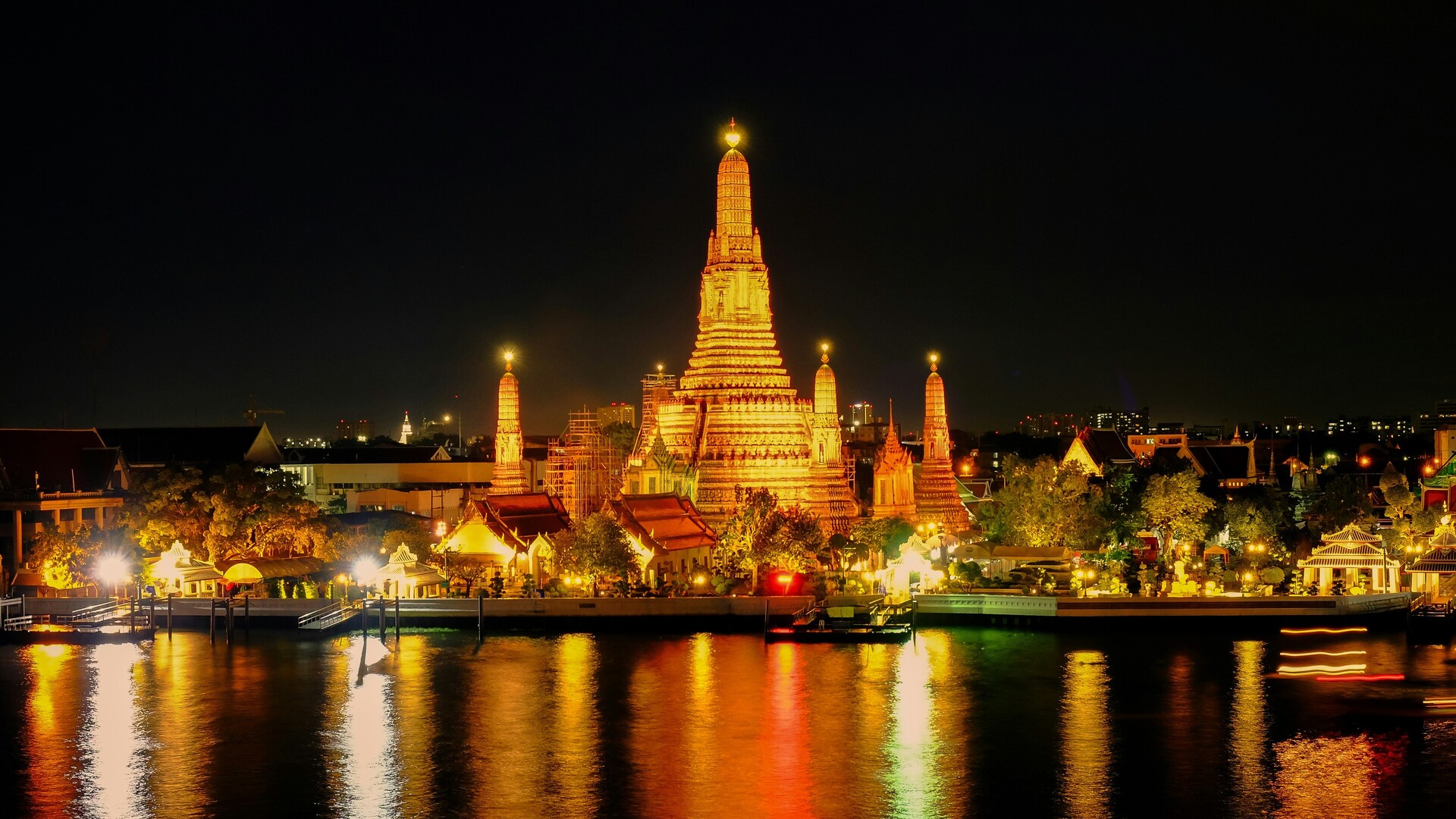
For the first time, the spirit of the Eurovision Song Contest is coming to Asia. Bangkok is the host city of the first Eurovision Song Contest Asia, which takes place on Saturday 14 November from 20:30 local time (ICT), that is 14:30 CET and 13:30 UTC. The Thai capital blends tradition and modernity, making it a fitting stage for this new chapter in the contest’s history.
Thailand is a Southeast Asian country with a constitutional monarchy. Its head of state is King Maha Vajiralongkorn (Rama X), and Anutin Charnvirakul serves as prime minister. Chadchart Sittipunt is the governor of Bangkok, having been re-elected for a second term in June 2026.
The country’s official language is Thai, although other languages and regional dialects are also spoken. Its currency is the Thai baht (THB), which is divided into 100 satang.
The Thai capital lies in the centre of the country, on the Chao Phraya River delta, a short distance from the Gulf of Thailand. The river runs through the city and is one of its main geographical and commercial arteries. Bangkok is the political, economic, financial and cultural centre of Thailand, and one of the leading cities of Southeast Asia.
Bangkok is a city of contrasts, where ancient Buddhist temples, royal palaces and traditional markets sit alongside skyscrapers, modern shopping centres and lively nightlife. Its historical and cultural heritage, together with its energy and international outlook, make it one of the most important tourist destinations in Asia.
The city covers around 1,569 square kilometres and has a registered population of roughly 5.5 million. The wider metropolitan area has more than 10 million residents. That makes Bangkok one of the great cities of the Asian continent.
On Saturday 14 November, the Thai capital makes history as the first host city of the Eurovision Song Contest Asia. The show takes place at the One Bangkok Forum and brings together artists from 11 countries: Bangladesh, Bhutan, Cambodia, Laos, Malaysia, Mongolia, Nepal, the Philippines, South Korea, Thailand and Vietnam. Under the slogan “United by Music”, this new musical venture aims to connect cultures, languages and traditions through music.
What is Eurovision Asia? Origin, format and date of the new contest
Discover Bangkok, a capital of contrasts between temples, markets and skyscrapers
Bangkok is one of those cities that are hard to take in at first sight. Densely populated, noisy and full of stimuli, the Thai capital combines Buddhist temples, palaces, markets, skyscrapers, shopping centres and busy street life. Everything coexists side by side, in a mix of tradition and modernity that is part of the city’s character.
Known to its inhabitants as Krung Thep, the “City of Angels”, Bangkok became the capital in 1782, during the reign of Rama I. Since then it has grown into a major 21st-century metropolis and one of the main tourist destinations in Southeast Asia. For first-time visitors, its size and the constant movement on its streets can be overwhelming, but it only takes a little time to start discovering a city full of nuance.
A city shaped by the river and its canals
The Chao Phraya River is one of Bangkok’s defining landmarks and also one of its main transport routes. Its waters carry passenger boats, ferries, barges loaded with goods and small local craft. For centuries, an extensive network of canals also linked different parts of the city, to the point that Bangkok was nicknamed the “Venice of the East”. Many of those canals disappeared as roads expanded, but water remains an essential part of life in the capital.
One of the best ways to see this other side of Bangkok is to travel along the Chao Phraya by boat. The trip offers a different perspective on the city and a close-up view of the constant flow of people and goods on the river. The boats that operate as river buses are also an inexpensive way to get around.
The Grand Palace, Bangkok’s historic heart
Of all the places to visit in Bangkok, the Grand Palace stands out. Construction began in 1782, the year the capital was founded, and for more than a century and a half it was the residence of Thailand’s kings. Although today it is used mainly for ceremonial occasions, it remains one of the country’s great architectural symbols.
The complex covers a large area and brings together numerous buildings, courtyards and ceremonial spaces. Within it stands Wat Phra Kaew, the temple that houses the Emerald Buddha, one of the most revered Buddhist images in Thailand. The statue, carved from green jade, is surrounded by gilded ornamentation and elaborate decoration.
Visitors can also see buildings such as the Dusit Throne Hall, the Aphorn Phimok Pavilion, the Chakri Throne Hall and the Siwalai Gardens. Bear in mind that strict dress rules apply, especially in the religious areas, where shorts and sleeveless tops are not allowed.
Temples that explain the city’s identity
Bangkok’s bond with Buddhism is visible in almost every neighbourhood. The city has hundreds of active temples, and it is common to see monks in their traditional saffron robes. Some of these temples are true icons of the capital.
One of the best known is Wat Arun, on the banks of the Chao Phraya and easily recognisable by its distinctive white architecture and tall central tower. Wat Pho, meanwhile, is famous for the huge reclining Buddha inside. The figure is 46 metres long and 15 metres high, and the temple is closely linked to traditional medicine and Thai massage.
Many other temples are worth discovering, such as Wat Benchamabophit, known as the Marble Temple; Wat Traimit, home to a large golden Buddha; and Wat Saket, the Temple of the Golden Mount, reached by climbing around 300 steps. The city’s religious heritage also includes Wat Suthat, Wat Intharawihan, Loha Prasat and Wat Mahathat.
Beyond the major monuments, part of Bangkok’s appeal lies in coming across small shrines and temples between modern buildings and wide avenues. That coexistence of old and new is one of the features that best defines the city.
Markets, shopping and street life
Bangkok is also best discovered on foot, among street stalls, markets and shopping districts. Chatuchak market is one of the best known and offers a huge variety of goods, from crafts and antiques to clothing, homeware, kitchenware and food. Its alleys form a genuine maze that reflects the liveliest and most chaotic side of the capital.
For those visiting on a weekday, Or Tor Kor market offers a different atmosphere, focused mainly on fruit and vegetables. After dark, Asiatique takes over, with shops, crafts, souvenirs and places to eat by the river, in a complex set in former warehouses.
Shopping is not limited to traditional markets. In areas such as Silom and Sukhumvit, the urban rail network links up with large shopping centres such as MBK. The BTS Skytrain and the MRT metro make it easier to get around a sprawling city where distances can be considerable.
Chinatown, Asian flavours and street food
Another of Bangkok’s best-known faces is Chinatown, known locally as Yaowarat. Historically linked to the Chinese community, the area is packed with shops, restaurants, cafés and street stalls that make it one of the city’s great food destinations.
By day its streets are busy with trade, notably the gold trade, while at night the pavements fill with food stalls. Yaowarat and Sampeng concentrate much of this activity, and nearby are the Pak Khlong Talat flower market and the Indian market of Phahurat.
For a more laid-back take on Bangkok, Khao San Road is also worth a visit. Bars, restaurants, travel agencies, bookshops and street stalls line this famous street, traditionally associated with backpackers. Its origins go back to the old rice market that was set up there in the late 19th century.
Museums that reveal another Bangkok
The Thai capital is not just temples and markets. It also has many spaces devoted to its history, art and everyday life. The National Museum holds objects and antiquities from different periods of Thai history, from prehistory to the ancient kingdoms and the Rattanakosin era. The National Gallery, for its part, houses works by Thai artists of different generations.
Other venues offer a more specific look at the country’s past. The House of Museums recreates aspects of everyday life in Bangkok in the 1960s through objects such as cameras, toys, school books and old household appliances. Also unusual are the Bangkok Doll Museum, devoted to handmade miniature creations, and the King Prajadhipok Museum, which focuses on the life of the king and queen.
The Jim Thompson House offers a different experience. The house, surrounded by greenery and built in the traditional Thai style, holds a significant collection of Southeast Asian antiques and artworks. Its owner was known for reviving the Thai silk industry and assembled a notable art collection over the years.
Parks and green spaces
Despite its size and intense urban activity, Bangkok also has green spaces where you can escape the noise of the streets for a few hours. Lumpini Park, in the Silom area, is one of the best known, combining space for walking and exercise with views of the city skyline. Chatuchak Park, with its lake and botanical garden, is another place to unwind.
Add to these Benjakitti, Benjasiri, Queen Sirikit and Rama IX parks. They show a calmer side of Bangkok and prove that the capital also has room for nature and rest.
A capital with a history of its own
Bangkok’s history cannot be understood without first looking at the former capitals of Siam. The Thai kingdom was first centred on Sukhothai, before moving to Ayutthaya, which ruled Siam from 1350 to 1767. After Ayutthaya was destroyed by the Burmese, the capital moved briefly to Thonburi until, in 1782, Rama I established Bangkok as the new capital.
The new city was built on the opposite bank of the Chao Phraya, partly following the model of Ayutthaya and keeping its relationship with the canals. The country’s later history was also shaped by its position between the spheres of influence of the European powers. Thailand managed to remain independent during the European colonial expansion in Southeast Asia, although it had to make significant economic and territorial concessions. During the Second World War, the country allied itself with Japan, and Bangkok was bombed in 1944 and 1945.
What makes Bangkok special?
Perhaps the most interesting thing about Bangkok is precisely that it cannot be summed up by a single attraction. It is a city of temples and shopping malls, historic palaces and skyscrapers, traditional markets and restaurants, wide avenues and narrow canals.
You can explore it by boat, get lost among the stalls of Chinatown, step into a temple, visit a museum, stroll through a park or end the day amid the lights and bustle of its streets. The food, the smells, the colours and the openness of its people complete an experience that rarely leaves visitors indifferent.
And there is still more to discover nearby. Around 70 kilometres away lies Ayutthaya, known for its historic ruins and a UNESCO World Heritage Site. Visitors can also head to Khao Yai National Park, the Damnoen Saduak Floating Market and the famous bridge over the River Kwai in Kanchanaburi.
Bangkok is not a city that reveals itself all at once. It takes time, walks and a willingness to be surprised. But that is exactly part of its appeal: around every corner a different scene can appear, and amid the noise, the temples, the markets and the traffic, a capital emerges with a personality of its own and a history that is still very much alive on its streets.