

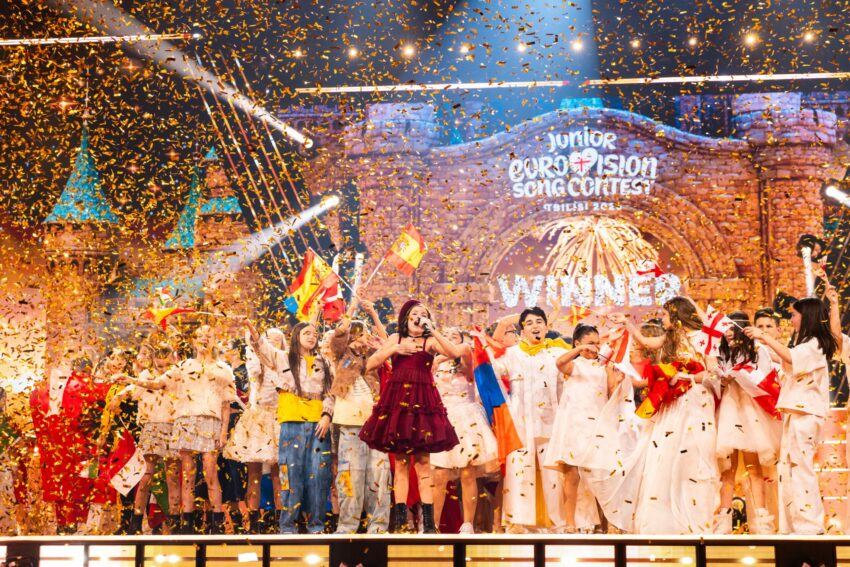
The Junior Eurovision Song Contest 2026 is now just over two weeks away. With preparations in full swing, this 24th edition brings one of the most striking changes of recent years: a new broadcast time.
As announced on Friday 24 July by the contest’s official website, relaunched that very day, the show will start at 21:00 CEST, a significant change from its usual time slot. Junior Eurovision thus leaves the afternoon slot and moves into prime time, returning to a time closer to that of its early editions, when it began at around 20:00.
In its most recent editions, Junior Eurovision has been held in the afternoon, between 16:00 and 18:00, a decision designed to make it easier for a children’s and family audience to watch. This move to peak viewing hours, however, brings the contest closer to the Eurovision Song Contest model, increasing its television presence and offering a wider broadcast window for European audiences.
Let us remember that in 2024, at the edition held in Madrid (Spain), host broadcaster Radiotelevisión Española (RTVE) tried to push the show as close to prime time as possible, starting at 18:00 CET. However, the different time zones across the continent led to disagreements among the participating public broadcasters. The following year, in 2025, Georgia brought the start forward again to 17:00 CET.
The European Broadcasting Union (EBU) has set the schedule of the Junior Eurovision Song Contest 2026, which will take place at the Malta Fairs & Conventions Centre (MFCC) in Ta’ Qali (Malta) on Saturday 24 October with 16 countries competing. Since then, other details of the contest have been revealed, such as its theme art and its stage design, both unveiled on 7 September.
The Junior Eurovision schedule, a key strategy to boost its audience
The move to 21:00 CEST may respond to the EBU’s aim of strengthening the image of Junior Eurovision as a major international music event and, in doing so, improving its television ratings. A slot closer to prime time makes it easier for families to be in front of the television and could bring greater media exposure for the young participating artists.
The new time could also allow a better fit for the contest within the schedules of the participating broadcasters, especially in countries where an afternoon broadcast may clash with other activities or events.
However, one aspect that must also be considered is the difference in time zones between the participating countries. For broadcasters in western Europe, such as Spain, Portugal or France, a show starting at 21:00 CEST fits within a usual prime-time slot, while for some countries in the east of the continent it means a later broadcast.
In Georgia or Armenia, which on 24 October will be two hours ahead of Central European Summer Time, the show will start at 23:00 local time and end after 01:00, something particularly relevant for a contest aimed mainly at a children’s and family audience. Any change of schedule therefore has to strike a balance between reaching a larger international audience and remaining accessible for all participating countries.
Take a look at the start time and running time of the Junior Eurovision Song Contest since its first edition in Copenhagen 2003:
| Edition | Date and start time | Running time |
|---|---|---|
| Copenhagen 2003 | Saturday 15 November | 20:00 CET | 2 hours 2 minutes |
| Lillehammer 2004 | Saturday 20 November | 20:15 CET | 2 hours 14 minutes |
| Hasselt 2005 | Saturday 26 November | 20:15 CET | 2 hours 11 minutes |
| Bucharest 2006 | Saturday 2 December | 20:15 CET | 2 hours 12 minutes |
| Rotterdam 2007 | Saturday 8 December | 20:15 CET | 2 hours 13 minutes |
| Limassol 2008 | Saturday 22 November | 20:15 CET | 2 hours 15 minutes |
| Kyiv 2009 | Saturday 21 November | 20:15 CET | 2 hours |
| Minsk 2010 | Saturday 20 November | 20:15 CET | 2 hours 2 minutes |
| Yerevan 2011 | Saturday 3 December | 19:30 CET | 2 hours 5 minutes |
| Amsterdam 2012 | Saturday 1 December | 20:15 CET | 2 hours 5 minutes |
| Kyiv 2013 | Saturday 30 November | 19:00 CET | 2 hours |
| Malta 2014 | Saturday 15 November | 19:00 CET | 2 hours 30 minutes |
| Bulgaria 2015 | Saturday 21 November | 19:30 CET | 2 hours 32 minutes |
| Valletta 2016 | Sunday 20 November | 16:00 CET | around 2 hours 32 minutes |
| Tbilisi 2017 | Sunday 26 November | 16:00 CET | 2 hours 11 minutes |
| Minsk 2018 | Sunday 25 November | 16:00 CET | 2 hours 27 minutes |
| Gliwice-Silesia 2019 | Sunday 24 November | 16:00 CET | 2 hours 27 minutes |
| Poland 2020 | Sunday 29 November | 17:00 CET | 1 hour 58 minutes |
| Paris 2021 | Sunday 19 December | 16:00 CET | 2 hours 40 minutes |
| Yerevan 2022 | Sunday 11 December | 16:00 CET | 2 hours 25 minutes |
| Nice 2023 | Sunday 26 November | 16:00 CET | 2 hours 28 minutes |
| Madrid 2024 | Saturday 16 November | 18:00 CET | 2 hours |
| Tbilisi 2025 | Saturday 13 December | 17:00 CET | around 2 hours 20 minutes |